Introduction: Fungi Beyond the Mushroom
Can Fungi Help Clean Up Pollution?
Growing the Building Materials of the Future
From Fungi to Mental Health Treatments
What Could Fungi Do Next?
References and Further Reading
Fungi offer promising solutions for environmental remediation, sustainable construction materials, and mental health treatments because of their unique biological and metabolic properties. While research and early commercial applications demonstrate significant potential, challenges involving scalability, safety, and scientific validation remain.
 Image credit: Cannabis_Pic/Shutterstock.com
Fungi are among the most diverse groups of organisms, and many species persist in extreme habitats around the world. This resilience and adaptability have prompted increasing research into their use in pollution control, building materials, and medicine.1
Introduction: Fungi Beyond the Mushroom
Although people often use the words mushroom, mycelium, and fungi interchangeably, each term has a different meaning. A mushroom is the visible fruiting body you can gather by hand; mycelium is the root-like vegetative network; and fungi refer to the entire organism. Mycelium consists of fine filaments called hyphae, each only 1–30 micrometers wide, with walls made of chitin and glucans rather than the cellulose found in plants.1,2
Fungi secrete enzymes that break down tough organic polymers; they colonize waste streams, and they synthesize molecules with pharmacological activity. These structural and metabolic traits of fungi have led to a growing research interest in understanding potential applications of fungi. This article explores applications of fungi in pollutant degradation, construction and packaging materials, and psychiatric medicine, and critically examines evidence found in clinical or commercial settings from what remains experimental.1
Can Fungi Help Clean Up Pollution?
Mycoremediation is a bioremediation strategy where the physiological or metabolic properties of fungi are used to remove, transform, detoxify, or immobilize contaminants. Fungi act through several routes. White-rot species, such as Phanerochaete chrysosporium, release extracellular enzymes like lignin peroxidase and manganese peroxidase that oxidize aromatic pollutants. The fungal cell walls of other filamentous fungi, such as Aspergillus niger, can bind metals by biosorption, and mycorrhizal partnerships help plants tolerate metal stress.3
One established example of mycoremediation involves P. chrysosporium and polycyclic aromatic hydrocarbons (PAHs) in soil. In unsterilized and untreated soil, the degradation rate of PAHs like phenanthrene and pyrene was observed to be 63.8% and 51.9%, respectively. Still, after treatment with P. chrysosporium, the degradation efficiency increased to 94.9% and 90.6%, respectively.3
The degradation of pharmaceutical residues by fungi has also been reported. Species such as Trametes versicolor and Pleurotus ostreatus have been reported to degrade up to 90% of pharmaceutical compounds, including diclofenac and ibuprofen, over weeks. However, several caveats apply to these reported figures. A high removal figure does not prove detoxification, since partial oxidation can leave intermediates that are equally or more toxic, and biosorption immobilizes metals instead of eliminating them.3,4
The performance also depends on pH, temperature, oxygen, and nutrients, with activity generally best at 20–30 °C. Cofactor costs and regulatory limits add further barriers. Field studies describe treatment periods of months to years and a frequent need for added interventions, and documented full-scale applications remain scarce.3,4
Companies are nonetheless entering the field. MycoMine, a Swedish company founded in 2021, has applied ascomycete fungi to soil bioremediation. They also report developing containerized treatment units for hydrocarbons, PAHs, halogenated compounds, per- and polyfluoroalkyl substances (PFAS), and dioxins, with treatment typically taking weeks to months and results confirmed by laboratory analysis. However, the company's stated treatment capabilities should not be interpreted as independent evidence of successful degradation of every listed pollutant, particularly highly persistent PFAS.1,5
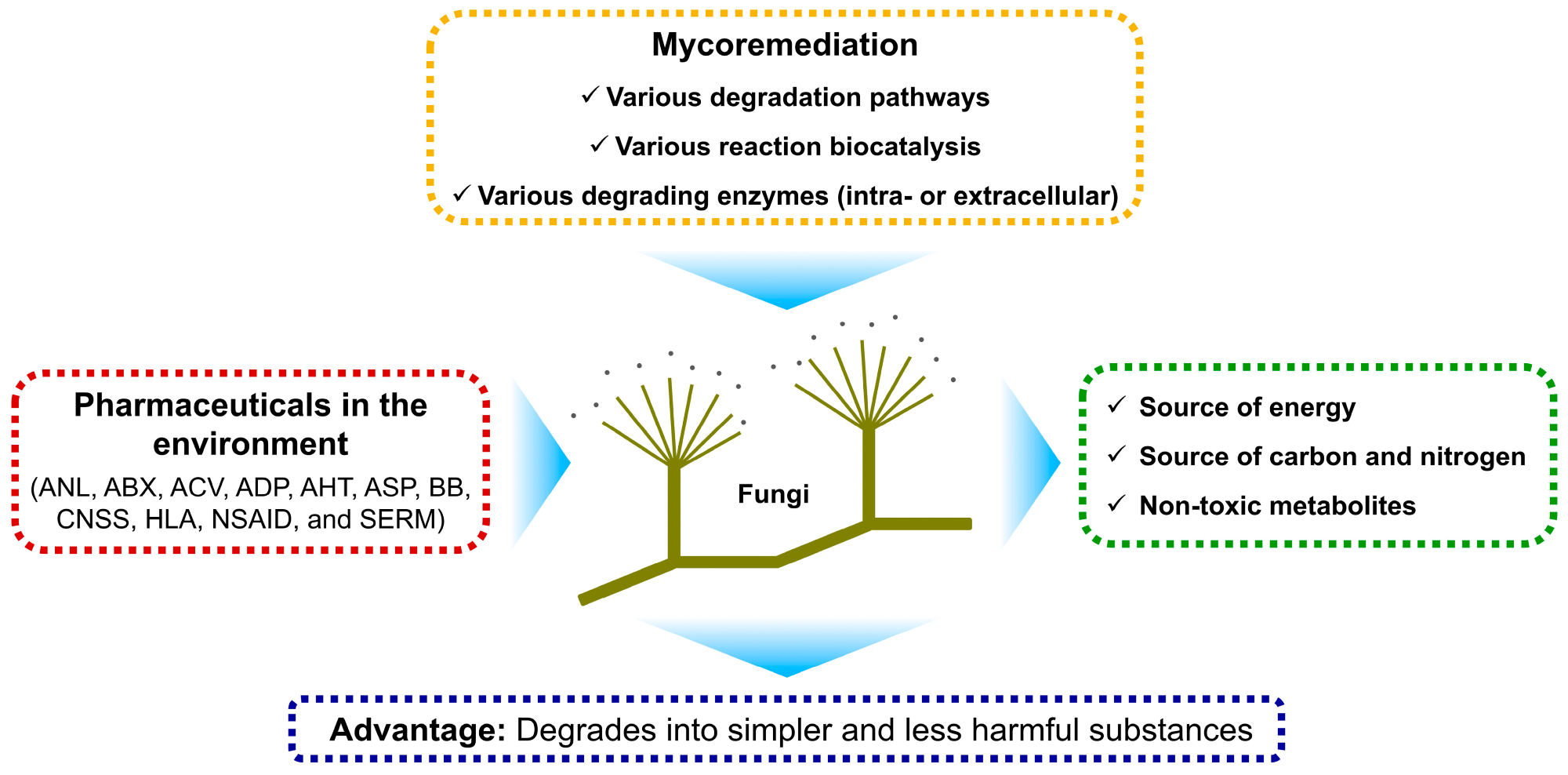 Schematic illustration of fungal mycoremediation, showing how fungi use intracellular and extracellular enzymes to degrade pharmaceutical contaminants into simpler compounds, potentially reducing their environmental toxicity. Image credit: Khan (2025).
Growing the Building Materials of the Future
Fungal mycelia can also act as a binder, and this property is being explored now for developing building materials known as mycelium-based composites (MBCs). In mycofabrication, a fungus is introduced into agricultural or forestry residues such as sawdust, straw, or rice husks, and its hyphae grow through the particles. Drying stops growth and leaves a rigid, closed-cell foam that is roughly 95% plant material and 5% mycelium by weight. Pressing during production further increases the material's density and strength.2
The thermal conductivity of MBCs is 0.05–0.07 watts per meter-kelvin, which is similar to that of glass wool and sheep wool. Some composites absorbed 70–75% of sound at 1000 Hz, which was much higher than the 11–31% observed for fiber boards. Mycelium also yields more char than plastics such as polylactic acid (PLA) and polymethyl methacrylate (PMMA) when burned, which can contribute to improved fire resistance, although char yield alone does not establish overall fire safety.2
However, MBCs also have water uptake of about 300%, as compared with 0.03–9% for polystyrene foams, and their compressive strength is only 0.03–4.44 MPa. Applications are therefore confined to non-structural or semi-structural uses. One estimate puts the lifespan of mycelium bricks below 50 years, and end-of-life impacts are understudied.2
The commercial applications of MBCs currently exist mostly in packaging and insulation. Mushroom Material in New Zealand makes packaging intended to replace polystyrene; Ecovative, based in New York, has supplied packaging trials with Dell and IKEA; Mogu in Italy produces acoustic panels and flooring; and Mykor in the United Kingdom is developing a rigid insulation board. The market remains small, with mycelium packaging valued at USD 68.1 million in 2024, and challenges such as material variability, slow production cycles, and the absence of standards still limit growth.1
From Fungi to Mental Health Treatments
Fungi also produce compounds with pharmaceutical potential, the best-known being penicillin, produced by Penicillium molds. However, growing research also supports the potential use of fungal compounds as psychotropic or psychiatric drugs.
Psilocybin, obtained from Psilocybe mushrooms, is being extensively studied for therapeutic use in affective disorders such as depression and anxiety. Psilocybin acts as a prodrug, a less active or inactive compound that the body metabolizes into its active form. After oral intake, phosphatases remove the phosphate group from psilocybin to form psilocin, a more lipid-soluble molecule that easily crosses the blood–brain barrier and acts mainly at 5-hydroxytryptamine receptor 2A (5-HT2A) serotonin receptors.6
Early clinical findings from psilocybin trials are encouraging. A meta-analysis of seven randomized trials with 436 participants found a moderate-to-large benefit over comparators. In a Swedish trial of 35 adults with recurrent major depression, a single 25 mg dose was compared with 100 mg niacin, and both groups received five psychotherapy sessions. Scores on the Montgomery-Åsberg Depression Rating Scale (MADRS) showed improvements with psilocybin at day 8. Although the advantage of psilocybin over niacin held at day 42, it was no longer significant at day 365.7,8
The studies also report some limitations. While no drug-related serious adverse events were reported, two participants in the psilocybin group experienced persistent, severe anxiety requiring medical attention. In the psilocybin group, 94.1% correctly guessed their allocation based on the psychedelic effects, suggesting that blinding was weak and it could have impacted the treatment effect size and biased the self-reported results. Another study noted that earlier psychedelic use was linked to larger effects, and antidepressant use may blunt treatment responses. They also warned that unregulated clinics could weaken the treatment protocol.7,8
What Could Fungi Do Next?
The physical and metabolic properties of fungi connect the three seemingly unrelated applications discussed here. Mycelial growth that penetrates substrates, extracellular enzymes that cleave resistant polymers, and metabolic pathways that yield bioactive molecules make fungi flexible biological platforms.1
Psilocybin is in late clinical evaluation, mycelium packaging and insulation have reached the market, and field mycoremediation is mostly at pilot scale. Progress in these areas depends on practical groundwork. Material producers need standardized manufacturing and testing, together with consistent life-cycle assessment to support sustainability claims. Commercial application of mycoremediation requires toxicity testing of breakdown products, long-term field validation, and regulatory acceptance. Similarly, clinical use of psilocybin for affective disorders requires larger trials with longer follow-up, more diverse participants, and better control of expectancy effects. In summary, fungi offer diverse solutions across scientific fields, but their broader impact will depend on overcoming the scientific and practical barriers to adoption.1-4,6-8
References and Further Reading
- Lurie-Luke, E. (2026). Mushroom biotech startups help address global challenges. Nature Communications, 17(1). DOI:10.1038/s41467-026-70167-y, https://www.nature.com/articles/s41467-026-70167-y
- Parhizi, Z., Dearnaley, J., Kauter, K., Mikkelsen, D., Pal, P., Shelley, T., & Burey, P. P. (2025). The Fungus Among Us: Innovations and Applications of Mycelium-Based Composites. Journal of Fungi, 11(8), 549. DOI:10.3390/jof11080549, https://www.mdpi.com/2309-608X/11/8/549
- Sevindik, M., Krupodorova, T., Gürgen, A., & Eraslan, E. C. (2026). Mycoremediation as a sustainable biotechnological approach for environmental pollution control. Environmental Sciences Europe, 38(1). DOI:10.1186/s12302-026-01365-0, https://enveurope.springeropen.com/articles/10.1186/s12302-026-01365-0
- Khan, M. F. (2025). Fungi for Sustainable Pharmaceutical Remediation: Enzymatic Innovations, Challenges, and Applications - A Review. Processes, 13(4), 1034. DOI:10.3390/pr13041034, https://www.mdpi.com/2227-9717/13/4/1034
- MycoMine. https://www.mycomine.se/ (accessed 11 Oct 2026).
- Thomann, J., Kolaczynska, K. E., Stoeckmann, O. V., Rudin, D., Vizeli, P., Hoener, M. C., Pryce, C. R., Vollenweider, F. X., Liechti, M. E., & Duthaler, U. (2024). In vitro and in vivo metabolism of psilocybin's active metabolite psilocin. Frontiers in Pharmacology, 15, 1391689. DOI:10.3389/fphar.2024.1391689, https://www.frontiersin.org/journals/pharmacology/articles/10.3389/fphar.2024.1391689/full
- Metaxa, A. M., & Clarke, M. (2024). Efficacy of psilocybin for treating symptoms of depression: systematic review and meta-analysis. BMJ, 385, e078084. DOI:10.1136/bmj-2023-078084, https://www.bmj.com/content/385/bmj-2023-078084
- Yngwe, H., Plavén-Sigray, P., Ekman, C. J., Henje, E., Berglund, A., Tiger, M., Beckman, M., & Lundberg, J. (2026). Short-Term and Late-Term Effects of Psilocybin on Symptoms in Major Depression: A Randomized Clinical Trial. JAMA Network Open, 9(5), e2612589. DOI:10.1001/jamanetworkopen.2026.12589, https://jamanetwork.com/journals/jamanetworkopen/fullarticle/doi/10.1001/jamanetworkopen.2026.12589
Last Updated: Oct 16, 2026