A national poll report finds declining trust in federal health agencies, shifting support for vaccines, and strong public opinion on recent dietary guidelines, one year into the current federal administration.
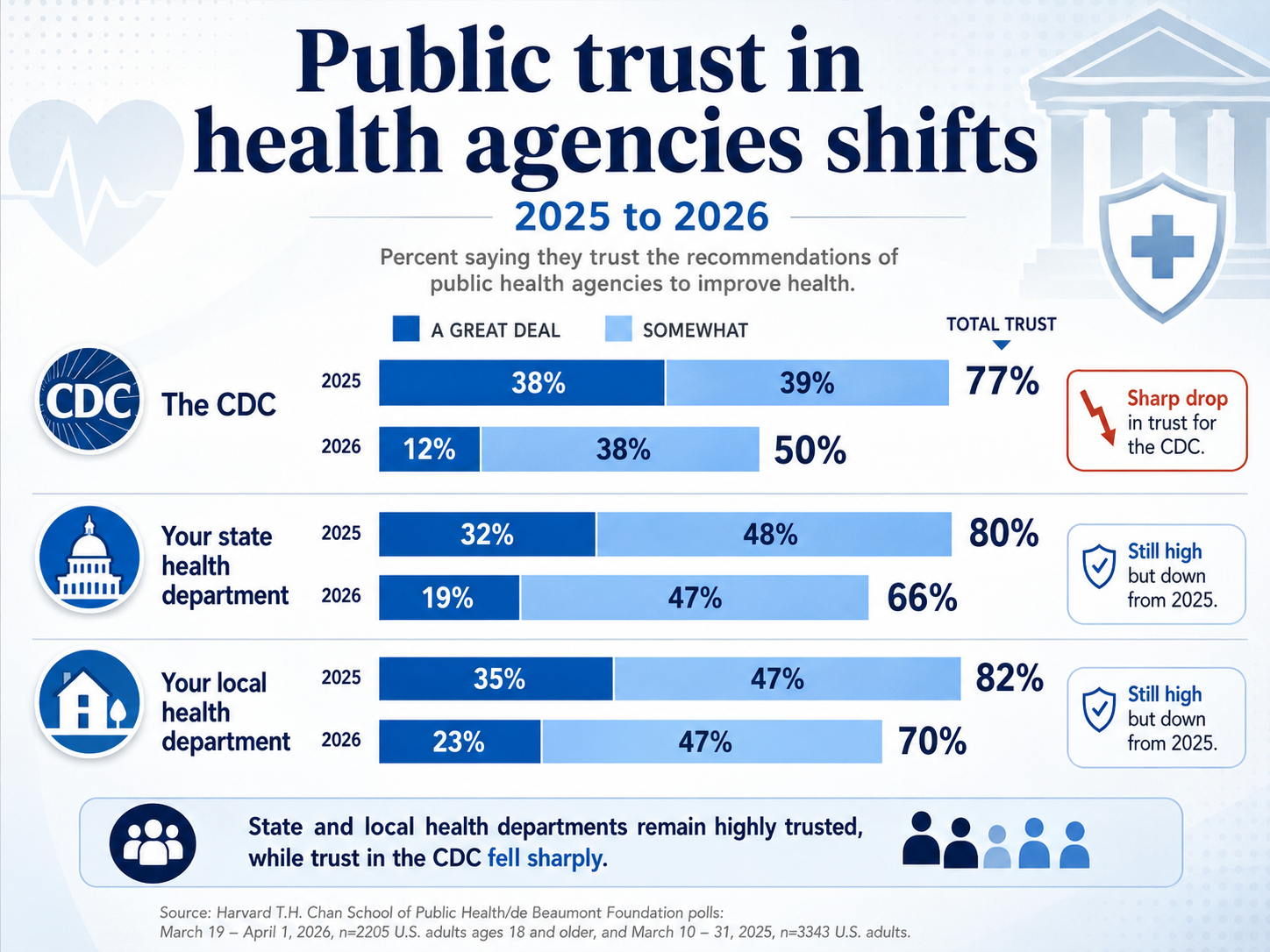
Image credit: Adapted from Harvard T.H. Chan School of Public Health and de Beaumont Foundation, One year in: Public views of a changing public health landscape (2026). Graphic created using OpenAI ChatGPT.
One year after new federal public health leadership began under the current administration, the Harvard T.H. Chan School of Public Health and the de Beaumont Foundation surveyed U.S. adults on their trust in public health agencies, attitudes toward vaccination, and opinions on recent changes to dietary guidelines.
Survey Design: Gathering Insights from Americans
Researchers from the Harvard Opinion Research Program and the de Beaumont Foundation designed the survey, with analysis conducted by researchers at Harvard Chan School and the fielding team at SSRS in Glen Mills, Pennsylvania. A probability-based, nationally representative sample of 2,205 U.S. adults ages 18 and older was interviewed in English or Spanish, responding online or by phone between March 19 and April 1, 2026. Respondents were reached online and by phone through the SSRS Opinion Panel, which recruited panelists via address-based and random-digit dialing sampling. The majority completed the survey online, and a smaller portion by phone.
As with all surveys, results are subject to sampling error. The margin of error was ±2.0 percentage points at the 95% confidence interval. Findings are compared to similar polls from 2019, 2021, 2022, 2023, and 2025. To ensure the results better reflect the U.S. adult population, researchers weighted the sample by selection probability, response rates, and key demographics. Additional measures, such as random sampling, repeated contact attempts, replicate subsamples, and systematic respondent selection within households, helped further reduce bias. Some questions, including several items on federal agency actions, childhood vaccination, and dietary guideline claims, were asked of random subsets rather than the full sample.
Crisis of Trust In Public Health
Trust in U.S. public health agencies, most notably the Centers for Disease Control and Prevention (CDC), has declined sharply one year into new federal leadership. By 2026, just 50% of the public trusts CDC recommendations, down steeply from 77% the previous year. Although trust in state and local agencies has also dropped, these remain more trusted than their federal counterparts. This sharp decline may signal waning confidence in national public health guidance and could influence public response to future health recommendations.
The report links much of this decline to deep partisan divides. Trust in the CDC fell dramatically among Democrats (from 92% to 34%) and Independents (from 77% to 47%), but rose modestly among Republicans (from 63% to 67%). Across demographic groups, trust also fell by at least 30 percentage points among women, Black and Hispanic adults, urban residents, and college graduates. The result is a widening gap that points to mounting polarization and heightened challenges for effective public health messaging.
In 2026, clinicians, including nurses, doctors, and pharmacists, remain the most trusted sources of health information, followed by friends and family, health associations and foundations, healthcare provider groups, and researchers. Among government agencies, local and state health departments rank highest in trust, while the CDC, U.S. Food and Drug Administration (FDA), National Institutes of Health (NIH), and other federal officials are viewed less favorably than clinicians and local or state agencies. This pattern underscores the critical role of local and personal sources in effective health communication.
Federal Public Health: Distrust and Division
A slim majority (55%) of U.S. adults now disapprove of federal public health agencies’ performance since early 2025, with approval sharply divided by party. Fewer than four in ten respondents agreed that agencies have made recommendations that follow the best available scientific evidence, and fewer than one-third agreed that they have reduced political or financial influence. Together, these findings suggest that declining trust is accompanied by broader doubts about agency priorities, process, and independence.
The majority of respondents agreed that federal health agencies have been overly influenced by personal beliefs, have the wrong priorities, and have cut or scaled back essential programs and funding. Many also agreed that these agencies are fueling polarization and widening health disparities. These concerns may undermine public support for agency actions.
Childhood Vaccines: Consensus and Conflict
Support for childhood vaccination requirements remains strong and stable, with large majorities across political parties backing requirements that children be vaccinated against preventable diseases such as measles, mumps, and rubella to attend school, excluding COVID-19 vaccination. This suggests enduring public consensus despite broader declines in institutional trust.
While most still oppose reducing the childhood vaccine schedule, a substantial minority, especially Republicans, supports it. This division may foreshadow future debate over vaccine policies. Overall, 58% opposed reducing the schedule, while 42% supported doing so.
Among those who support reducing the vaccine schedule, major reasons include concerns about too many vaccines, a desire for parental control, and skepticism about vaccine necessity or safety. These views reflect distrust in the current system and preference for individualized decision-making.
Among those who oppose reducing the vaccine schedule, major reasons include concerns that it would increase illness, undermine generally accepted vaccine safety and child health protection, and be based on insufficient evidence. Many also worry about negative effects on lower-income families and children who may be less likely to be vaccinated if requirements are reduced. This perspective is rooted in trust in established science and public health protection.
Views of childhood vaccine safety remain high overall, with 89% saying routine childhood vaccines are very or somewhat safe for most children. However, the share saying they are “very safe” fell from 63% in 2025 to 57% in 2026, closer to pre-pandemic levels.
Dietary Guidelines: Unity and Controversy
A majority of respondents support recent changes to the food pyramid and the Dietary Guidelines, especially the emphasis on limiting sugar and highly processed foods. Support was also strong for recommendations to increase protein intake. However, there is partisan division over recommendations to increase beef and whole milk. These divides may shape the acceptance and implementation of nutrition policy.
Many respondents agreed that the new Dietary Guidelines include clear, widely accepted advice and could improve food programs. However, half agreed that the guidelines may have been influenced too much by “big agriculture,” and smaller shares questioned some health impacts. These findings reflect public opinion about the changes, not an independent assessment of their nutritional validity.
Bridging Divides to Restore Public Confidence
According to the poll, trust in U.S. public health institutions has eroded sharply in recent years, marked by deepening political divisions and skepticism toward federal agencies. While support for core public health measures, such as childhood vaccinations and updated dietary guidelines, remains strong in some areas, partisan gaps and concerns about influence and priorities threaten the effectiveness of national health messaging. Moving forward, rebuilding trust will require transparent communication, a renewed focus on local partnerships, and sustained efforts to depoliticize public health guidance.
Download your PDF copy by clicking here.
 Tobacco giants helped push ultra-processed foods into global markets