Researchers have recommended isoprene to be used as a marker in human breath to assess blood cholesterol. The use of breath isoprene has been theoretically proved as an effective and non-invasive diagnostic tool in determining the variations in blood cholesterol levels in humans.
Isoprene is washed from the muscles and exhaled during exercise. The pulmonary gas exchange process is thought to be the key mechanism behind this. This is apparent with an initial increase in expired concentration, followed by a decrease and stabilization.
The HPR20 Transient MS (Figure 1) was found to be suitable for this application, due to its quick response, extensive dynamic range and improved sensitivity provided by a PIC detector. A heated Quartz Inlet Capillary (QIC) was fixed to a modified proprietary breathing mask.
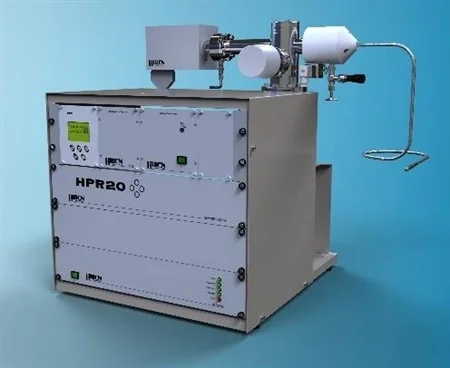
Figure 1. The Hiden HPR20 Transient MS. Image Credit: Hiden Analytical
Experimental
A submaximal exercise regimen was set on a stationary bicycle for subjects of different ages and fitness levels. The control of resistance was given to the subject, and the effort level was controlled via the rate of perceived exertion. The test procedure included 1 minute's rest, gentle exercise for 5 minutes followed by a 5 minute rest period.
The initial level of isoprene was estimated to be ∼50 ppbv. From Figure 2, the initial 'washing out' of the isoprene from the muscles to the blood stream was observed to be approximately 200 ppbv.
Following this, the isoprene level was lowered to a baseline level, indicating the failure of blood isoprene level to return to its initial level during the rest period. The blood isoprene level was then increased to the initial level only after an hour of rest.
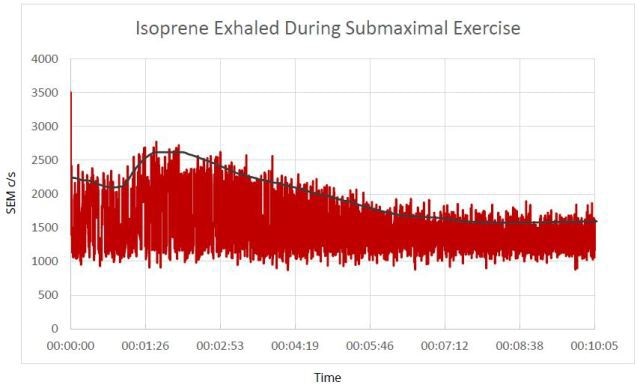
Figure 2. Trend data showing the change in isoprene concentration in expired breath during a submaximal exercise test. Image Credit: Hiden Analytical
Figure 3 shows the isoprene levels of each breath obtained using the HPR20 Transient MS. This also indicates the quick response of the instrument. Using these results, both end tidal as well as breathing rate can be measured. The results obtained were in contrast with the offline measurements that do not provide detailed information.
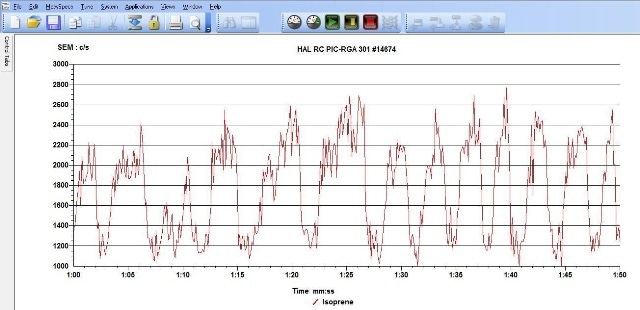
Figure 3. MASsoft v7 Data showing breath by breath isoprene levels during an exercise test. Image Credit: Hiden Analytical
Conclusion
The results prove the viability of performing analysis of exhaled isoprene in real time. They also demonstrate that the Hiden HPR-20 TMS is a versatile and high sensitivity tool for rapid analysis of compounds in human breath.
About Hiden Analytical
With over 40 years of expertise in quadrupole mass spectrometer design and development, Hiden Analytical is a leading global manufacturer of scientific instruments for advanced research and specialized process monitoring.
Innovation driven by customer needs has shaped Hiden’s reputation for excellence and established a strong foundation built on technical expertise and close collaboration with clients. Hiden delivers cutting-edge solutions that enhance analytical capabilities and support the advancement of customer research and product development.
Hiden’s global presence is supported by an extensive network of representatives and service centers across North and South America, Europe, the Middle East, Africa, China and the Asia-Pacific region. As a privately owned company, Hiden prioritizes building long-term relationships with customers, many of whom are pioneering breakthroughs in plasma research, surface science, vacuum processing, and gas analysis. Their teams of application specialists provide responsive, expert support wherever clients are based.
Renowned for precision and performance, Hiden’s instruments address a broad spectrum of applications, including high-accuracy gas analysis, plasma diagnostics, SIMS for ultra-high vacuum surface studies, catalysis evaluation, and thermogravimetric analysis - spanning pressures from 30 bar to UHV/XHV. Recent developments include advanced electrochemistry solutions such as the HPR-40 DEMS and HPR-20 OEMS systems, along with the next-generation QGA 2.0, which builds on the original QGA platform with significant enhancements for improved performance and ease of use.
Hiden’s commitment extends beyond delivering high-specification, reliable instruments. They maintain ongoing collaboration with customers to ensure their solutions consistently meet and exceed expectations.
Sponsored Content Policy: News-Medical.net publishes articles and related content that may be derived from sources where we have existing commercial relationships, provided such content adds value to the core editorial ethos of News-Medical.net, which is to educate and inform site visitors interested in medical research, science, medical devices and treatments.