This article integrates Bambanker™ product instructions and peer-reviewed use cases into a practical framework for selecting a formulation, regulating the freeze-thaw workflow, and determining the suitability of recovered cells for downstream usage.
This literature-informed article does not include any fresh comparative experimental data, and rather converts the current Bambanker product instructions and peer-reviewed applications into a usable workflow.
Summary
Reliable cell banking relies on regulating the entire freeze-thaw workflow, not just the freezing stage or immediate post-thaw viability. This article outlines a four-stage structure that includes initial material quality, freezing, storage and transportation, and post-thaw recovery.
It specifies what should be checked and documented at each stage to improve uniformity and traceability.
The article explains how the various Bambanker™ formulations serve individual cell types and workflow requirements through ready-to-use handling, direct freezing at -80 °C without programmed or sequential cooling, and long-term -80 °C storage without mandatory liquid nitrogen transfer.
Published applications demonstrate how recovery has been assessed using model-relevant outcomes beyond immediate viability.
Selecting the Bambanker™ type
Source: NIPPON Genetics EUROPE GmbH
| Product |
Best for |
Key differentiator |
When to choose |
|
Bambanker™
Standard
|
|
Versatile medium, broad-use |
Default option for routine cell banking |
| Bambanker™ hRM |
- ES (Embryonic Stem Cells)
- iPS (induced Pluripotent Stem Cells)
|
Contains human serum albumin |
Xeno-free, serum-free workflow is preferred |
| Bambanker™ DMSO Free |
|
No DMSO |
DMSO is undesirable (e.g., protocols minimizing DMSO exposure) |
| Bambanker™ Direct |
- Hybridoma cells
- High-throughput (HTP) applications
|
No cell centrifugation is required |
Time-efficient freezing workflow, especially on high-throughput freezing days |
Formulation selection should be based on the current product manual, cell model, and laboratory-validated technique. Evidence derived from one formulation should not be immediately transferred to another.
Bambanker™ workflow
- Prepare: Select cells that match prescribed culture-quality parameters. Keep track of identity, passage or population doublings, contamination levels, morphology, and viability prior to freezing.
- Harvest: Collect cells and remove culture media as per the validated cell-specific methodology.
- Resuspend: For optimal results, start with 1 x 10⁶ viable cells per 1 mL of Bambanker™. Validate any changes to cell concentration or fill volume in the model.
- Vial and freeze: Transfer the suspension to labeled cryovials and freeze at -80 °C. Bambanker™ does not require programming or sequential freezing.
- Store: Use verified -80 °C storage. Document the freezer or tank, rack, box, position, formulation, lot, and freezing date. If necessary, cells can be moved to LN2.
- Thaw and recover: Follow established recovery conditions before applying model-relevant acceptability criteria.
Bambanker™ Direct further streamlines the cryopreservation process. It is mixed directly into cells in culture media at a 1:1 ratio, avoiding the requirement for centrifugation in compatible applications.
Control the complete workflow
Bambanker™ simplifies cryopreservation, but reproducibility requires controls before freezing, during freezing, in storage, and post-thawing.
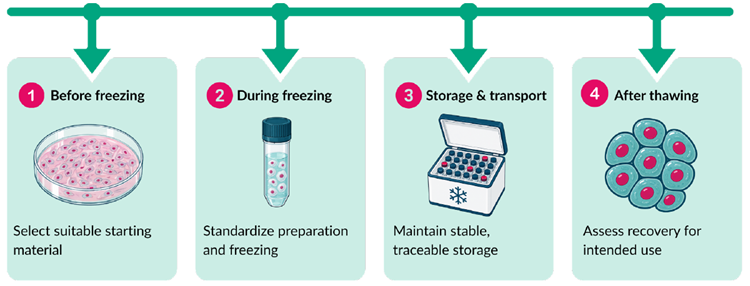
Image Credit: NIPPON Genetics EUROPE GmbH
1. Before freezing: Define suitable starting material
Cryopreservation cannot cure contaminants, an inappropriate passage history, unusual shape, or poor developmental behavior. Before collecting cells, define the model's approval criteria.
Source: NIPPON Genetics EUROPE GmbH
| Control point |
Confirm |
Record |
| Culture state |
Expected morphology and growth behavior |
- Confluence where relevant
- Observed deviations
|
| Passage history |
Accepted passage or population doubling range |
- Passage number or population doublings
|
| Culture quality |
Cell identity is confirmed, and no evidence of contamination. |
- Identity check
- Contamination-testing status
|
| Cell quantity |
Sufficient viable cells for the planned bank |
- Cell count
- Viability method
- Planned number of vials
|
| Downstream purpose |
Intended use and recovery decision defined |
- Intended application
- Recovery period and relevant recovery endpoint
|
Begin with appropriate cells and the Bambanker™ type matched to the model.
- Bambanker™ supports popular cell lines
- Bambanker™ hRM for human ES/iPS cells
- Bambanker™ DMSO Free is ideal for delicate workflows that avoid DMSO
- Use Bambanker™ Direct for hybridoma processes or cells that are susceptible to centrifugation stress
Bambanker™ cannot compensate for low starting material quality; however, formulation choice can adjust the freezing strategy.
2. During freezing: Standardize the remaining variables
Once the culture is cleared for banking, the goal is to complete the freezing technique regularly. Important variables include the cryopreservation liquid used, cell concentration, and fill volume.
These factors should be defined in a written procedure prior to the freeze session. Standardization does not necessitate one uniform setting for all cell types; rather, it necessitates a technique for each model that can be repeated and compared across operators and freezing runs.
Source: NIPPON Genetics EUROPE GmbH
| Control point |
Confirm |
Record |
| Medium and formulation |
The selected cryomedium is appropriate for the model and protocol. |
- Bambanker™ formulation
- Bambanker™ lot
- Bambanker™ expiry
- Timely transfer to -80 °C storage
|
| Cell concentration |
The number of viable cells per vial and fill volume are defined according to the validated cell-specific protocol. |
- Viable-cell concentration per vial
- Fill volume
|
Direct freezing
at −80 °C |
Cryovials are transferred directly to a validated -80 °C freezer without controlled-rate or stepwise cooling. |
- Date of transfer
- Any delay or deviation
|
| Labeling |
Every vial has a unique, readable identifier before storage. |
- Cell model, passage, date, operator, medium, and vial ID
|
Bambanker™ focuses on the most important preparation variables. It is supplied ready to use, is free of FBS, requires no dilution, and does not require programmed or sequential freezing.
Cells are resuspended in the specified formulation, transported to appropriate cryovials, and frozen at -80 °C.
This eliminates the possibility of operator-to-operator variance from the composition of serum-containing mixtures on the day of use and sophisticated cooling algorithms. Cell concentration, fill volume, handling time, labeling, and variations must all be monitored and recorded.
Although Bambanker™ removes on-the-day preparation of freezing mixes and controlled-rate cooling, laboratories still need to standardize viable-cell concentration, fill volume, handling time, labeling, and transfer to -80 °C.
3. Storage: Maintain stability and traceability
Following freezing, workflow control moves from sample preparation to ensuring proper storage conditions and consistent sample identification.
The laboratory's validated protocol should specify the storage system, monitoring strategy, inventory structure, vial integrity, and retrieval procedure. Storage temperature is not the only control factor.
A structured inventory enables a vial to be found before the storage container is opened, minimizing wasted searching during retrieval. Each vial should have a unique identifier that corresponds to its contents, freezing history, and exact storage location.
Source: NIPPON Genetics EUROPE GmbH
| Control point |
Confirm |
Record |
| Storage conditions |
The storage system operates within the laboratory’s validated conditions |
- Storage unit, set point, monitoring status, and relevant alarms
|
| Inventory location |
Each vial can be located without unnecessary searching |
- Freezer or tank, rack, box, position, and unique vial identifier
|
| Vial and label integrity |
The vial remains securely closed, and the identification remains readable |
- Vial type, labeling format, and any observed damage
|
Operational rule: Before accessing the storage unit, determine the exact location of each vial.
Bambanker™ enables long-term cell preservation at -80 °C. The Bambanker™ procedure does not require transfer to liquid nitrogen at -196 °C (though it is possible). This can reduce reliance on LN2 equipment and handling in laboratories that follow a proven -80 °C procedure.
Freezer monitoring, appropriate cryovials, inventory control, and traceability remain critical. Keep the Bambanker™ type and lot associated with each vial record.
4. After thawing: Assess recovery before use
Thawing represents the start of recovery, not the end of the workflow. Immediate viability provides an early sign of survival, but it does not always indicate whether cells have recovered the properties required for downstream application.
Depending on the model, key recovery outcomes could be attachment, proliferation, differentiation potential, subset composition, phenotype, morphology, three-dimensional structure, or assay-specific function.
Define the assessment before thawing a vial: when will recovery be examined, what endpoint will be measured, and what outcome will allow the culture to continue? This avoids measuring success retrospectively or using a single generic viability criterion.
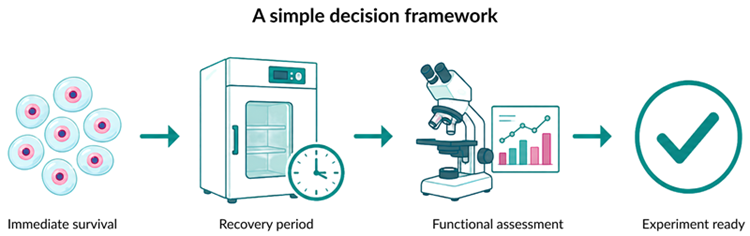
Image Credit: NIPPON Genetics EUROPE GmbH
Source: NIPPON Genetics EUROPE GmbH
| Control point |
Confirm |
Record |
| Thawing procedure |
The same validated warming and handling procedure is used |
- Vial ID, thawing method, date, time, and operator
|
| Recovery conditions |
Cells are placed under appropriate and consistent culture conditions |
- Recovery medium, vessel, seeding density, and incubation conditions
|
| Immediate survival |
The initial assessment uses a defined method and time point |
- Viability method, viable cell count, and time after thawing
|
Recovery
period |
Cells receive the predefined recovery time before evaluation or use |
- Recovery start, assessment time, and any medium changes
|
| Experiment readiness |
Cells meet the model-specific criteria required for downstream use |
- Selected endpoints, results, and decision to use or reject the culture
|
Published Bambanker™ procedures have investigated outcomes beyond immediate viability, such as growth and phenotypic changes in cultivated corneal endothelium cells, functional recovery of iPSC-derived dopaminergic neurospheres, and single-cell molecular profiling of patient-derived breast cancer tissue.
Examples from Bambanker™ studies
The papers below show how recovery from cryopreservation using Bambanker™ was tested in several experimental systems. The table summarizes the authors' stated cell models and downstream applications, as well as recovery endpoints and assessment time points.
Because the research employed diverse models and experimental methodologies, the findings should be interpreted in the context of each investigation rather than by directly comparing Bambanker™ formulations or applying universal acceptability criteria.
The presented experimental methods are study-specific and do not replace the current Bambanker™ formulation-specific instructions.
Source: NIPPON Genetics EUROPE GmbH
| Cell model and application |
Recovery
endpoints |
Assessment
timing |
Reference |
| Human corneal endothelial cells |
- Viability by Trypan Blue
- Attachment
- Proliferation
- Cell density
- Monolayer formation and morphology
- Actin distribution
- Expression of ZO-1, N-cadherin, and Na+/K+-ATPase
|
- Viability immediately after thawing
- Attachment after 24 hours
- Growth, cell density, morphology, and marker expression after 28 days
|
1 Okumura et al., 2019 |
| Human iPSC-derived dopaminergic neurospheres |
- Viability
- Neurite extension
- Dopaminergic and neural-cell marker expression
- Gene expression
- Electrophysiological activity
- Dopamine secretion
- Graft survival and maturation
- Behavioral response after transplantation
|
- Viability at 24 hours; neurite extension at day five
- Marker and gene expression assessment at day seven
- Electrophysiology and dopamine secretion after further maturation
- In vivo assessment over several months
|
2 Hiramatsu et al., 2022 |
| Patient-derived breast cancer tissue |
- Recovery of tumor, stromal, and immune-cell populations by single-cell RNA sequencing
- Detection of cell-lineage and breast-cancer receptor-status markers
- Transcript expression and matched immunohistochemistry
|
- Following thawing, tissue dissociation, and preparation for single-cell analysis
|
3 Restivo et al., 2022 |
Defining experiment readiness
The last conclusion is whether the recovered cells are appropriate for their intended use. The most useful assessment is determined by the cell model and downstream experiment; a single quality-control panel should not be used uniformly for all cultures.
Examples of model-relevant post-thaw quality control. Source: NIPPON Genetics EUROPE GmbH
Cell
model |
Examples of model-
relevant endpoints |
Why it matters |
| Adherent cell lines |
Attachment, morphology, proliferation |
Healthy attachment and growth indicate successful recovery. |
| Primary cells |
Viability, morphology, phenotype |
Primary cells are often more sensitive to cryopreservation and functional changes.4-5 |
| PBMCs/T cells |
Viability, subset composition, activation after stimulation |
Immune function may be affected even when viability remains high.6 |
| Stem cells/iPSCs |
Colony formation, pluripotency markers, differentiation potential |
Functional potency is more informative than survival alone. |
| Organoids/spheroids |
Structural recovery, regrowth, tissue-specific markers |
Three-dimensional architecture must recover before experiments begin. |
| Patient-derived samples |
Culture initiation, molecular profiling, assay performance |
The objective is preservation of characteristics relevant to the intended analysis. |
Define the post-thaw acceptance criteria before freezing the cells
Success should be measured against the criteria of the subsequent experiment, not against a single viability threshold.
Template: At [assessment time], recovered [cell model] may proceed to [intended experiment] when [method] shows [defined threshold or acceptable range]. Results outside this range trigger [additional recovery, investigation, or rejection].
Practical cryopreservation checklist
Use this checklist to ensure that the main cryopreservation variables are specified, managed, and recorded. Adapt the checklist to the established protocol for the specific cell model.
Source: NIPPON Genetics EUROPE GmbH
| |
|
|
|
| Cell model |
|
Date |
|
| Operator |
|
Protocol followed |
|
| Bambanker™ formulation |
|
Cell density |
|
| Bambanker™ lot |
|
Number of vials |
|
1. Before freezing
- Identify post-thaw use and recovery requirements
- Ensure culture satisfies model-specific acceptance standards
- Record passage numbers and population doublings
- Cell count and viability are recorded before freezing
- The required bank size has been determined
2. During freezing
- Confirm the proper cryopreservation medium and formulation
- Target cell concentration is defined
- Define the number of cells per vial and fill volume
- Follow the verified process for mixing or resuspension
- Controlled handling time before freezing
- Each vial has a distinct, readable identifier
- All procedure deviations are noted
3. Storage
- Confirmed storage conditions
- Each vial's exact position is documented
- Monitoring and alarm systems are operational
- Plan for retrieval or transfer before opening the storage facility
- Use proper transport methods for the conditions
- Document any warming occurrences, delays, damage, or labeling issues
4. After thawing
- The vial identity and sample history are validated
- A validated thawing technique is followed
- The recovery medium, seeding density, and culture conditions are specified
- Records immediate cell viability and yield
- Recovery period is concluded
- Model-specific recovery endpoints are evaluated
- Experiment preparedness is validated and documented
Conclusion
Reliable cryopreservation should be assessed based on whether the recovered cells are appropriate for their intended purpose. Immediate viability is a vital first step, but the recovery interval, assessment time, and model-relevant acceptance criteria should be established prior to freezing.
Using serum-free Bambanker™ cryopreservation media simplifies preparation and reduces handling steps. However, the freezing medium remains a part of the workflow.
Combining simplified medium handling with clearly defined control points throughout all four stages builds a better platform for consistent, traceable cell banking and dependable post-thaw use.
References and further reading
- Okumura, N., et al. (2019). Feasibility of a cryopreservation of cultured human corneal endothelial cells. PLOS ONE, 14(6), p.e0218431. DOI:10.1371/journal.pone.0218431. https://journals.plos.org/plosone/article?id=10.1371/journal.pone.0218431.
- Hiramatsu, S., et al. (2022). Cryopreservation of Induced Pluripotent Stem Cell-Derived Dopaminergic Neurospheres for Clinical Application. Journal of Parkinson’s disease, 12(3), pp.871–884. DOI:10.3233/JPD-212934. https://journals.sagepub.com/doi/10.3233/JPD-212934.
- Restivo, G., et al. (2022). Live slow-frozen human tumor tissues viable for 2D, 3D, ex vivo cultures and single-cell RNAseq. Communications Biology, 5(1). DOI:10.1038/s42003-022-04025-0. https://www.nature.com/articles/s42003-022-04025-0.
- Bahsoun, S., Coopman, K. and Akam, E.C. (2020). Quantitative assessment of the impact of cryopreservation on human bone marrow-derived mesenchymal stem cells: up to 24 h post-thaw and beyond. Stem Cell Research & Therapy, 11(1). DOI:10.1186/s13287-020-02054-2. https://link.springer.com/article/10.1186/s13287-020-02054-2.
- François, M., et al. (2012). Cryopreserved mesenchymal stromal cells display impaired immunosuppressive properties as a result of heat-shock response and impaired interferon-γ licensing. Cytotherapy, 14(2), pp.147–152. DOI:10.3109/14653249.2011.623691. https://www.isct-cytotherapy.org/article/S1465-3249(12)70625-4/abstract.
- Li, B., et al. (2022). Comprehensive evaluation of the effects of long-term cryopreservation on peripheral blood mononuclear cells using flow cytometry. BMC immunology, 23(1), p.30. DOI:10.1186/s12865-022-00505-4. https://link.springer.com/article/10.1186/s12865-022-00505-4.
About NIPPON Genetics EUROPE GmbH
Our contribution to your success – we are committed to ensuring that you can achieve your goals!
NIPPON Genetics EUROPE is a global biotech company founded in 2005 with its own research, development, and production based in Germany. By providing an extensive range of selected and groundbreaking products for the life science sector, we would like to be a reliable partner and contribute to achieving our customers' individual goals. The majority of our employees have a scientific background because we want to understand which problem solutions our customers care about.
Sponsored Content Policy: News-Medical.net publishes articles and related content that may be derived from sources where we have existing commercial relationships, provided such content adds value to the core editorial ethos of News-Medical.net, which is to educate and inform site visitors interested in medical research, science, medical devices, and treatments.