Improving early, accurate cancer diagnosis is a top priority for oncology researchers and clinicians. Circulating proteins are currently at the center of such initiatives, serving as minimally invasive biomarkers capable of revealing real-time biology that reflects the ongoing disease condition.
Protein biomarkers could be used to identify disease changes that appear before clinical diagnosis. Multi-protein signatures have the potential to improve disease detection accuracy and aid in the early differentiation of various cancer types.
Olink not only offers next-generation proteomics solutions for discovering and developing such biomarkers, but it also allows scientists to construct their own research questions and compare their significant discoveries to premium datasets developed using Olink technology.
Data from landmark proteomic studies is now freely available to the scientific community via interactive data stories in Olink® Insight, a sophisticated online tool designed to facilitate the interpretation of complicated proteome datasets in the context of current biological knowledge.
This article describes one such resource, which is based on a remarkable cancer proteomics dataset.
The Disease Atlas: Cancer interactive data story is based on data from Professor Mathias Uhlén and SciLifeLab in Uppsala, Sweden.
They carried out a pan-cancer analysis of protein associations with 15 different cancer types, measuring approximately 1500 proteins in plasma from over 1800 patients from the Uppsala-Umeå Comprehensive Cancer Consortium (U-CAN) biobank.
The proteomics of cancer
The study focuses on how protein expression changes between cancer types. This enables, for example, comparison and investigation of observed protein expression profiles for each cancer type, identifying strong indicators for each.
The following example demonstrates how to choose or search for proteins of interest to generate NPX distributions and ROC curves.
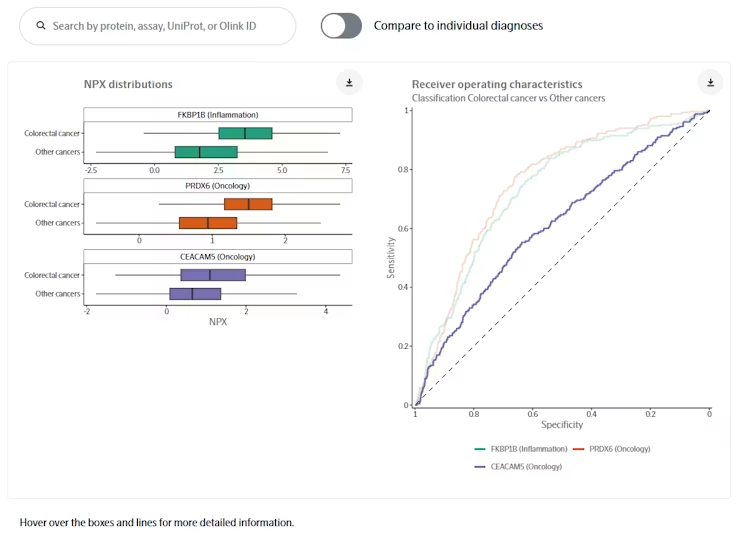
Image Credit: Olink®- Part of Thermo Fisher Scientific
Other interactive features include:
- Use Lasso logistic regression to identify the top 10 proteins associated with each malignancy, whether they are differentially expressed or up-regulated.
- Use volcano plots, categorization algorithms, and Reactome pathways to gain a deeper understanding of specific cancer types.
- Analyze receiver operating characteristic (ROC) curves to determine the effectiveness of selected markers in distinguishing between cancer types.
For research use only. Not for use in diagnostic procedures.
© 2026 Olink Proteomics AB, part of Thermo Fisher Scientific. Olink products and services are For Research Use Only. Not for use in diagnostic procedures.
About Olink®- Part of Thermo Fisher Scientific
Olink’s mission is to accelerate proteomics together with the scientific community, to understand real-time biology and gain actionable insights into human health and disease. Our innovative solutions deliver highly sensitive and accurate protein quantification, giving scientists the power to investigate complex biological processes with precision.
One platform. Endless possibilities.
Explore up to 5,400 proteins with high specificity, transparent data, and the flexibility to answer any research question. Meet the next-generation proteomics platform trusted by the scientific community, from small academic research teams through to leading pharma companies.
Sponsored Content Policy: News-Medical.net publishes articles and related content that may be derived from sources where we have existing commercial relationships, provided such content adds value to the core editorial ethos of News-Medical.net, which is to educate and inform site visitors interested in medical research, science, medical devices and treatments.