Archived blood samples collected years before cancer diagnosis gave researchers a rare opportunity to examine whether molecular changes in circulating DNA appear long before disease is clinically detected.
Study: Pre-diagnosis plasma cell-free DNA reveals early signatures of prostate and breast cancer risk up to eight years prior to clinical detection
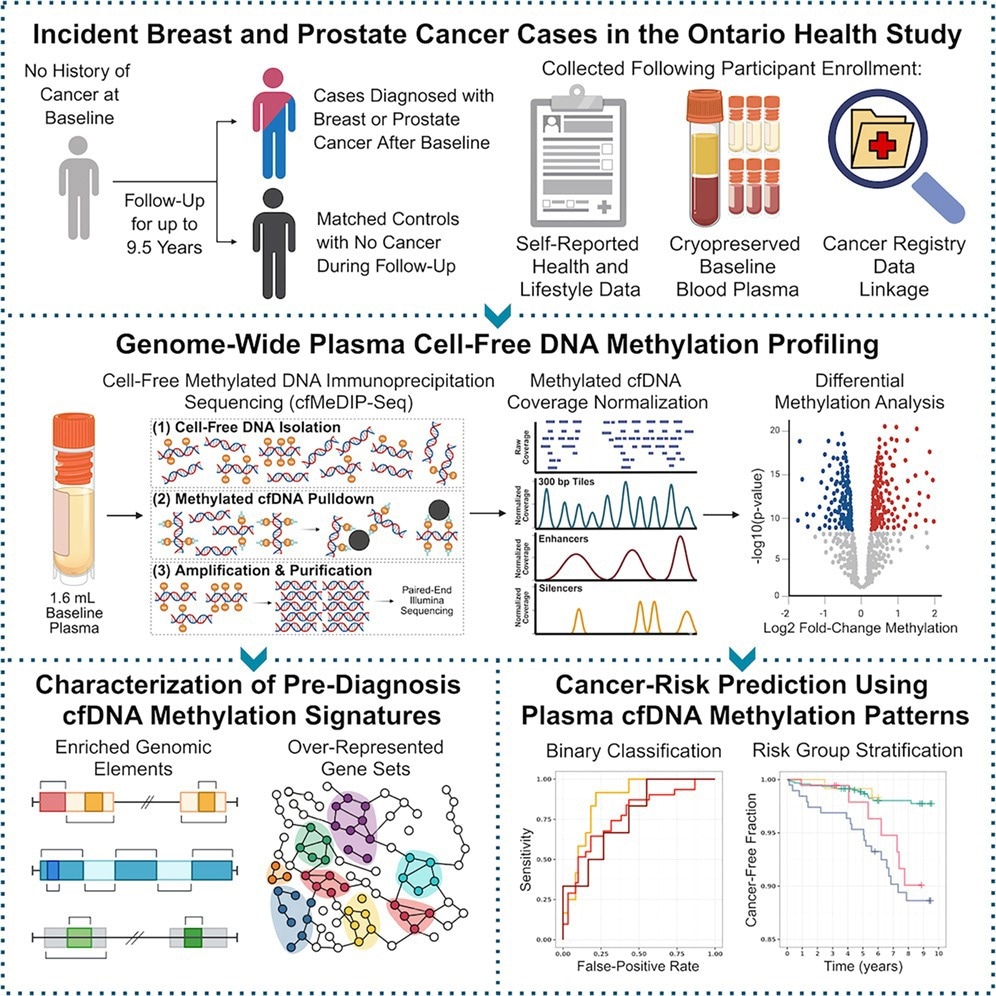
A recent study in the journal Cell Genomics suggests that genome-wide cell-free deoxyribonucleic acid (cfDNA) methylation patterns may help stratify cancer risk years before diagnosis, with stronger pre-diagnostic performance for prostate cancer than for breast cancer. In particular, silencer methylation could help stratify prostate cancer risk up to eight years before clinical detection, while breast enhancer signals vary by disease subtype and stage.
Those classified as high risk had a 3.55-fold higher rate of prostate cancer diagnosis during follow-up, while the corresponding breast cancer estimate was 2.3-fold higher. However, the breast cancer result was uncertain and did not meet the conventional threshold for statistical significance, suggesting that plasma cfDNA methylation may have potential for cancer risk stratification.
Early cancer detection could facilitate prompt treatment and improve patient outcomes and quality of life. Cancers in their initial stages are comparatively easier to treat than advanced cancers that may have spread to other tissues and organs. Strategies that identify individuals at elevated cancer risk before clinical diagnosis could potentially enable earlier evaluation and intervention.
About the study
In the present study, researchers investigated whether regulatory cfDNA methylation signals for breast and prostate cancer risk could be detected years before clinical diagnosis. They analyzed 491 plasma samples and used machine learning to evaluate methylation signals. Samples from participants who later developed cancer were collected two weeks to nine years before diagnosis. In total, 171 samples were obtained from individuals who later developed breast cancer, 93 from those who later developed prostate cancer, and 227 from cancer-free controls.
For analysis, the team linked Ontario Health Study (OHS) data from more than 40,000 individuals to Canadian Cancer Registry health records. This helped identify participants who were cancer-free at study initiation but later developed cancer and select controls matched by sex, age, sampling period, and lifestyle and health factors such as alcohol intake and smoking.
The researchers performed cfDNA immunoprecipitation sequencing (cfMeDIP-seq) to explore the methylome. After excluding samples with poor immunoprecipitation efficiency or low library complexity, differentially methylated regions (DMRs) were assessed for enrichment across genomic regions.
The team trained logistic regression models using a discovery dataset comprising 70% of age-matched participants without cancer and those whose cancer was detected within five years of study initiation. They investigated whether cfDNA methylation markers could distinguish individuals who later developed breast or prostate cancer, including those diagnosed up to nine years after baseline.
To assess generalizability, the researchers explored cfDNA methylation profiles in external datasets involving prostate cancer, head and neck squamous cell carcinomas (HNSCCs), non-cancer controls, and participants with advanced breast cancer from the Ontario-wide Cancer Targeted Nucleic Acid Evaluation (OCTANE) study. They compared pre-diagnosis cfDNA DMRs with genomic DNA (gDNA) data from prostate (n = 502) and breast (n = 846) cancer tissues, adjacent normal tissues, and peripheral blood leukocytes (PBLs).
Results
The mean age at diagnosis was 66 years for prostate cancer and 60 years for breast cancer. Stage I and II prostate tumors represented 28% and 52% of cases, respectively, and Gleason scores of 6 and 7 accounted for 32% and 52%. Among the breast cancer group, stage I tumors represented 68% of cases.
The DMRs frequently mapped to regulatory regions and repetitive sequences. Between 38% and 51% overlapped enhancers, promoters, or silencers, while 61% to 86% occurred within repetitive sequences. In these DMRs, DNA methylation patterns showed similarities to those observed in cancer tissues and immune cells. In particular, the team found significant enrichment of inflammatory pathways involving tumor necrosis factor alpha (TNF-α) and interleukin-2 (IL-2)-signal transducer and activator of transcription 5 (STAT5) signaling in cfDNA from both cancer groups.
In cfDNA DMRs from participants with prostate cancer, enrichment was observed in the mechanistic target of rapamycin (mTOR), mitogen-activated protein kinase (MAPK), Kirsten rat sarcoma virus (KRAS), and p53 signaling pathways. The cfDNA DMRs from participants with breast cancer showed enrichment of p53, DNA repair, and hypoxia pathways.
Methylation signals in cfDNA silencer regions could stratify future prostate cancer risk, with high-risk individuals showing a 3.55-fold higher hazard after adjustment for age, alcohol consumption, and family history. While enhancer hypermethylation modestly predicted breast cancer, these changes strongly distinguished late-stage disease. In the held-out test set, the breast cancer high-risk group had an estimated 2.3-fold higher hazard than the low-risk group, but the estimate was imprecise and did not meet the conventional threshold for statistical significance.
Pre-diagnosis plasma cfDNA DMRs showed concordant differentially methylated CpG sites in bulk cancer tissues compared with PBLs, but many signals also appeared in corresponding normal tissues and may reflect tissue-of-origin or immune-cell biology. The prostate signature also distinguished established localized and metastatic disease, and the breast signature distinguished established late-stage breast cancer. Using OHS-derived cutoffs of 0.15 and 0.40, the eight-year cancer incidence rates were 11.3% and 6.2% in the high-risk groups for prostate and breast cancer, respectively, compared with 1.8% in each low-risk group.
For pre-diagnostic breast cancer, the enhancer classifier achieved AUROCs of 0.62 in the discovery set and 0.58 in the held-out test set. For established late-stage breast cancer, the AUROC was 0.87 when cases were compared with OHS breast cancer-free controls and 0.94 when compared with external non-breast cancer samples. For pre-diagnostic prostate cancer, biomarkers based on the top 100 cfDNA silencer DMRs achieved AUROCs of 0.78 in the discovery set and 0.73 in the test set.
The authors noted several limitations, including small sample sizes in rarer cancer subtypes, variable follow-up among controls, and the absence of an independent external cohort for prospective validation of the risk models.
Overall, the findings suggest that plasma cell-free DNA may reveal molecular signatures associated with future breast and prostate cancer years before clinical detection, with stronger pre-diagnostic risk stratification for prostate cancer. If confirmed in larger, independent prospective studies, such approaches could eventually complement existing screening and risk-assessment strategies, with breast cfDNA testing serving as an adjunct rather than a replacement for mammography.
 City of Hope develops adaptive plug-and-play CAR T technology to attack tumors