Introduction
Mechanistic evidence in cartilage and joint tissue
Clinical evidence in humans
Observational and real-world evidence
Limitations and research gaps
Future directions
References
Further reading
Researchers are investigating how appetite- and blood-glucose-regulating drugs interact with cartilage, inflammation, and osteoarthritis biology.
 Image Credit: TripleP Studio / Shutterstock.com
Introduction
Osteoarthritis (OA) is the most common joint disorder and a leading cause of pain and disability worldwide. This condition is characterized by progressive degeneration of articular cartilage, accompanied by changes in subchondral bone, synovium, and other joint tissues.
Beyond mechanical loading, inflammatory and metabolic changes may also contribute to OA development. For example, overweight and obese individuals are more likely to develop hand OA, suggesting that systemic metabolic effects contribute beyond mechanical loading. As the disease progresses, people with OA often experience symptoms like persistent joint pain, stiffness, swelling, and progressive limitation of motion.1,2
Obesity-related changes may precede clinical symptoms, suggesting that weight-loss therapies warrant investigation for their potential to preserve long-term joint health. Guidelines recommend weight loss for people with knee or hip OA who are overweight or obese, and greater losses, including 10% or more, may produce larger improvements in knee pain.
Achieving this degree of weight loss through lifestyle interventions alone is challenging for many individuals. This has led researchers to investigate alternative approaches, such as glucagon-like peptide-1 receptor agonist (GLP-1 RA) therapy, to improve joint health through weight reduction.1
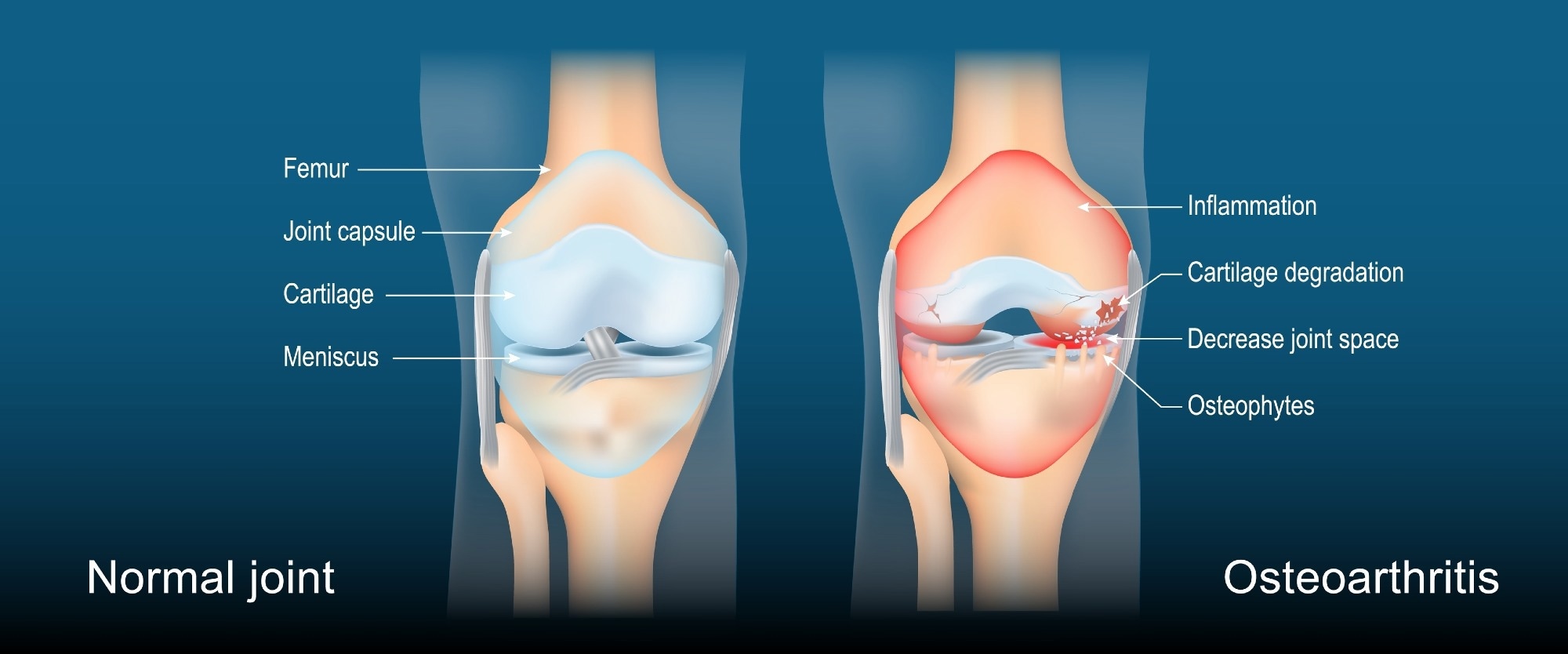 Image Credit: Designua / Shutterstock.com
Mechanistic evidence in cartilage and joint tissue
Experimental studies have identified GLP-1 receptor expression in cartilage, synovium, meniscus, and other joint tissues. Preclinical studies suggest that GLP-1 receptors may reduce inflammatory signaling in chondrocytes, the cells that maintain cartilage, with GLP-1 RA therapy potentially inhibiting pathways involved in cartilage breakdown.1,2
In cell and animal models, GLP-1 RAs suppress nuclear factor kappa B (NF-κB) signaling and reduce inflammatory mediators, including interleukin-1 beta (IL-1β), IL-6, IL-8, IL-12, and tumor necrosis factor α (TNF-α). Separate experiments report reduced reactive oxygen species and lower expression of cartilage-degrading enzymes, including matrix metalloproteinase-3 (MMP-3), MMP-13, and aggrecanases ADAMTS-4 and ADAMTS-5, helping preserve type II collagen and aggrecan.2
In animal models, GLP-1 RAs reduce cartilage degradation, synovial inflammation, and pain sensitivity. By suppressing catabolic processes and promoting anabolic processes, GLP-1 RAs may reduce extracellular matrix (ECM) degradation while promoting collagen synthesis.
In one mouse study, a single intra-articular injection of 20 μg of liraglutide produced analgesia comparable to 20 μg of dexamethasone on days 3 and 7, with a greater effect on day 10. These experimental findings do not establish equivalent efficacy or dosing.
Preclinical findings suggest effects beyond weight reduction; however, weight-independent chondroprotection remains unproven in humans. By activating the PI3K/Akt pathway, GLP-1 RAs like liraglutide reduce pro-apoptotic proteins such as cleaved caspase-3 and Bax while increasing the anti-apoptotic protein Bcl-2 in chondrocytes.1,2
Semaglutide in Obesity and Knee Osteoarthritis | NEJM
Clinical evidence in humans
Few independent randomized trials have evaluated GLP-1 RAs in OA, and their results differ. The STEP 9 trial showed that semaglutide reduced body weight and alleviated knee pain in obese individuals with knee OA. Over 68 weeks, body weight fell by 13.7% with semaglutide versus 3.2% with placebo, accompanied by greater pain relief and improved physical function.1,2
A separate 52-week liraglutide trial found no additional knee pain benefit over placebo, measured using the Knee Injury and Osteoarthritis Outcome Score (KOOS), even with greater weight loss. Participants had already completed an intensive dietary intervention and lost an average of 12.5 kg before randomization, which may have limited further pain improvement. A secondary analysis of the same trial reported better KOOS function scores but no increase in objectively measured physical activity.1
STEP 9 assessed pain using the Western Ontario and McMaster Universities Osteoarthritis Index (WOMAC). Differences in participant characteristics, baseline pain, dietary preparation, and treatment duration limit comparisons with the liraglutide trial.
Neither study directly compared the two drugs, so their results cannot establish semaglutide’s superiority over liraglutide. Furthermore, these trials do not establish a weight-independent analgesic effect shared by all GLP-1 RAs.1,2
Observational and real-world evidence
Being overweight or obese exacerbates cartilage damage and joint deformity, which can contribute to OA development and progression. Beyond randomized trials, a small, uncontrolled study of 40 people with knee OA and type 2 diabetes reported an average weight reduction of 8.3 kg over six months of dulaglutide treatment, together with improved pain and reduced non-steroidal anti-inflammatory drug (NSAID) use. Its single-arm design limits causal interpretation.2
Observational evidence also suggests an association between GLP-1 RA use and fewer knee procedures. For example, the Shanghai Osteoarthritis Cohort study reported knee surgery in 1.7% of GLP-1 RA users versus 5.9% of non-users among people with knee OA and type 2 diabetes. The outcome combined total and partial knee replacement, arthroscopy, and high tibial osteotomy. Weight reduction mediated part of this association, and the study cannot establish that treatment prevented surgery.1,2
The Shanghai cohort also reported improvements in WOMAC pain scores after adjustment for weight change and blood glucose control. Magnetic resonance imaging (MRI) findings from the same cohort suggested slower cartilage loss in the medial femorotibial joint among GLP-1 RA users. Randomized trials must confirm these observational associations before establishing direct analgesic or cartilage-preserving effects 1,2
Observational findings remain susceptible to differences in baseline risk, treatment selection, comorbidities, and follow-up. Differences in clinical surveillance and diagnosis may also affect comparisons. GLP-1 RA effectiveness may differ by age, sex, and diabetes status, but these subgroup effects remain uncertain.2
 Image Credit: AnimaFlora PicsStock / Shutterstock.com
Limitations and research gaps
Beyond STEP 9, large randomized trials designed around OA outcomes remain limited, particularly for structural disease progression. Variability in drug dosage and intervention duration across trials complicates the assessment of GLP-1 RA treatments. Most human evidence concerns knee OA in people with obesity or diabetes, limiting application to other joints and populations.
Long-term structural outcomes remain insufficiently studied. Preclinical/reclinical studies also have limitations; many used young male animals, and incomplete reporting made it difficult to assess risk of bias. Human studies have not yet confirmed the proposed direct anti-inflammatory mechanisms within affected joints.1
Gastrointestinal adverse effects, including nausea and vomiting, can affect treatment continuation. Longer follow-up is needed to assess tolerability, adherence, and safety when these drugs are studied for OA. Confirmatory randomized trials and long-term safety monitoring are needed to establish their clinical role. In these trials, researchers should stratify participants by obesity status, disease severity, and joint involvement and assess whether statistically significant changes produce meaningful benefits for patients.2
Future directions
Future studies should determine whether GLP-1 therapies can preserve cartilage, whether benefits extend beyond weight reduction, and which patients are most likely to benefit. Dual agonists such as tirzepatide, which activate both GIP and GLP-1 receptors, also require separate evaluation. Comparative studies should assess differences between individual drugs and distinguish the contributions of weight loss, glucose control, and direct joint effects. Current evidence supports symptom improvement in selected populations, while prevention of structural progression remains a research objective.1,2
References
- Cheng, J., Solomon, T., Estee, M., et al. (2025). Effect of glucagon-like peptide-1 receptor agonists in osteoarthritis: A systematic preclinical, clinical, and human studies. preclinicalis and Cartilage Open 7; 1. DOI: 10.1016/j.ocarto.2025.100567. https://www.sciencedirect.com/science/article/pii/S2665913125000032
- Li, Y., Yang, L., Li, F., et al. (2025). Emerging therapeutic potential of glucagon-like peptide-1 receptor agonists in knee osteoarthritis: a systematic review. Frontiers in Pharmacology 16; 1627691. DOI: 10.3389/fphar.2025.1627691. https://www.frontiersin.org/journals/pharmacology/articles/10.3389/fphar.2025.1627691/full
Further Reading
Last Updated: Oct 20, 2026