Introduction: What is glycation?
How glycation occurs in the body
AGEs and cellular damage
Glycation, inflammation, and oxidative stress
Effects on skin and visible aging
Glycation and age-related disease
Can glycation be reduced?
References
Further reading
What happens when sugars react with the proteins that support your skin and tissues? Scientists are examining the chemistry of glycation and whether changing dietary exposure could influence long-term health.
 Image Credit: nobeastsofierce / Shutterstock.com
Introduction: What is glycation?
Glycation is a spontaneous, non-enzymatic reaction in which reducing sugars such as glucose and fructose covalently bind to the free amino groups of proteins, lipids, or nucleic acids. This reaction initially results in the formation of unstable Schiff bases that rearrange into more stable early glycation products, including Amadori products derived from glucose and Heyns products derived from fructose, through the Maillard reaction.1 Further structural rearrangements and oxidation can produce advanced glycation end products (AGEs).1
AGE accumulation reflects the balance between formation, tissue turnover, and clearance, including elimination by the kidneys. Long-lived proteins, such as collagen, are particularly susceptible to accumulating AGE modifications.1,2 As AGEs accumulate, they can impair the mechanical properties of the skin and the functional integrity of internal organs, contributing to tissue damage and cellular senescence.1,2
How glycation occurs in the body
The formation of endogenous AGEs, which are byproducts of normal cellular metabolism, is influenced by sugar concentrations, oxidative stress, and the availability of reactive carbonyl compounds, including glyoxal and methylglyoxal.1,3 For example, elevated blood glucose concentrations accelerate glycation, while fructose is more reactive than glucose because a greater proportion exists in an open-chain form.1 This difference in chemical reactivity does not by itself establish the health effects of consuming particular sugar-containing foods.1
AGEs form gradually over time in healthy individuals, but hyperglycemic states like diabetes mellitus accelerate glycation and AGE accumulation.1 Exogenous dietary AGEs (dAGEs) are formed when high-temperature, dry-heat cooking methods like roasting accelerate the Maillard reaction.4 Food composition, cooking time, temperature, and moisture influence the amount formed.1,4
How do Advanced Glycation End Products cause us to grow older quicker?
AGEs and cellular damage
AGEs can cause structural and functional alterations in cellular components. For example, some AGEs form rigid covalent cross-links between neighboring proteins, reducing tissue elasticity.2 Others modify proteins without forming cross-links or affect cells through receptor signaling.1,2
Glycation can alter protein structure and, in some cases, impair the activity of metabolic enzymes or cellular receptors. Within the extracellular matrix, cross-linked proteins become highly resistant to normal proteolytic turnover and repair processes, thereby contributing to persistent tissue dysfunction.3
AGEs can be classified by their source, chemical precursor, fluorescence, and ability to form cross-links. Classification by fluorescence and cross-linking produces four groups: fluorescent cross-linked, fluorescent non-cross-linked, non-fluorescent cross-linked, and non-fluorescent non-cross-linked AGEs.1 Pentosidine is a fluorescent cross-linked AGE, while argpyrimidine is fluorescent but does not form cross-links.1
Non-fluorescent cross-linked AGEs include glyoxal-lysine dimer (GOLD), formed from glyoxal, and methylglyoxal-lysine dimer (MOLD), formed from methylglyoxal.1 Nε-carboxymethyllysine (CML) is a non-fluorescent, non-cross-linked AGE that can form through both glycation and lipid peroxidation pathways.1,2 These categories describe chemical properties, with individual AGEs differing in their biological effects.1,2
Glycation, inflammation, and oxidative stress
In addition to their direct effects on cell structural integrity, AGEs may also damage cells by binding to the transmembrane receptor for AGEs (RAGE).5 In vitro studies indicate that this AGE-RAGE interaction activates signaling pathways involving transcription factors like nuclear factor-kappa B (NF-κB) and promotes the release of pro-inflammatory cytokines like interleukin-1β (IL-1β), IL-6, and tumor necrosis factor-alpha (TNF-α).5,6
AGE-RAGE signaling can also activate NADPH oxidases, increasing reactive oxygen species (ROS) production and contributing to oxidative injury.5 Oxidative stress can promote further AGE formation, sustaining a cycle of inflammation and tissue damage.3,5
Effects on skin and visible aging
The human skin, particularly its dermal layer, is susceptible to AGE accumulation and glycation-related changes. Structural proteins, such as collagen and elastin, have been identified as primary targets for AGE cross-linking.4
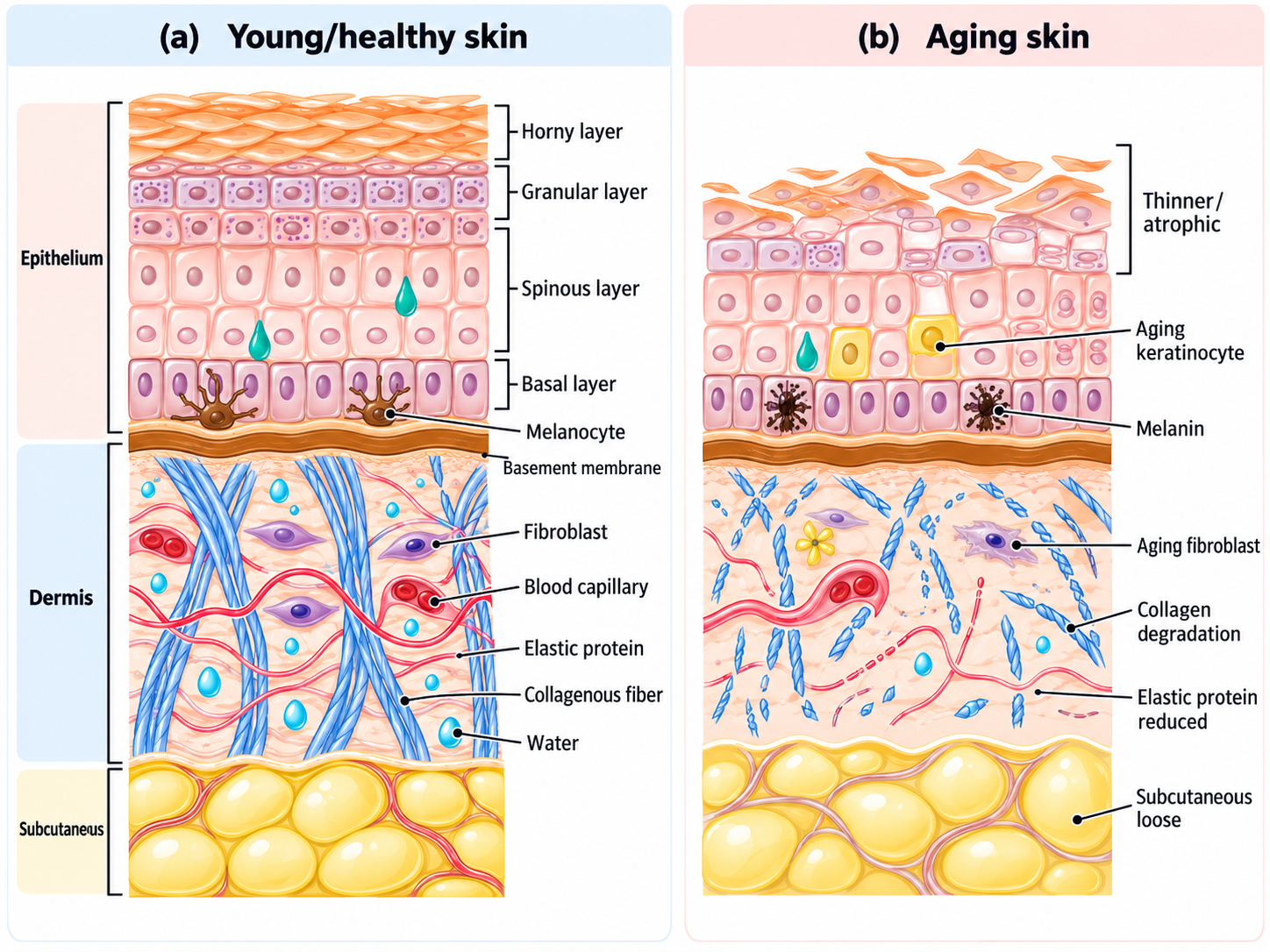
(a) Schematic diagram of skin structure, (b) Schematic diagram of skin structure after aging. This picture compares changes between young skin and aged skin.4
Once glycation and cross-linking occur, these proteins can lose flexibility, increasing dermal tissue stiffness. These changes can reduce skin elasticity and contribute to visible aging, alongside other processes such as ultraviolet damage and age-related changes in collagen production.4
In cultured human skin cells, exposure to glyoxal-derived AGEs (GO-AGEs), particularly together with ultraviolet B (UVB) irradiation, increased inflammatory signaling and oxidative stress. Experiments in dermal fibroblasts also showed increased matrix metalloproteinase release and reduced type I collagen expression. These laboratory findings support a possible mechanism of skin damage, but effects on human wrinkles were not tested.6
 Image Credit: PeopleImages / Shutterstock.com
In patients with diabetes, AGEs are implicated in microvascular and macrovascular injury, including mechanisms involved in diabetic nephropathy.1,5 In cardiovascular disease, AGE-induced cross-linking of vascular collagen can contribute to arterial stiffening.5
Skin autofluorescence provides a noninvasive, indirect estimate of tissue AGE accumulation by measuring fluorescence. The signal reflects fluorescent tissue compounds and correlates with levels of some non-fluorescent AGEs; however, it does not directly quantify every AGE species.8 Furthermore, this approach does not measure RAGE abundance or AGE-RAGE binding.
A systematic review and meta-analysis found associations between higher skin autofluorescence and several diabetic complications, but skin pigmentation, topical products, and other factors can affect measurements. Further validation is needed before it can be treated as a stand-alone diagnostic or predictive test.8
A separate meta-analysis found higher skin autofluorescence in patients with diabetic foot ulcers than in those without ulcers. Collectively, these findings support further investigation of its use in risk assessment, but do not establish AGE accumulation as an independent cause of ulceration.9
AGE accumulation and RAGE signaling have also been implicated in neurodegenerative disorders, including Alzheimer's and Parkinson's diseases. Experimental evidence links glycation to altered protein aggregation, oxidative stress, and neuronal injury. In Alzheimer's disease research, AGE modifications have been identified in amyloid-beta plaques and tau-containing neurofibrillary tangles, while RAGE signaling has been linked to microglial activation and neuroinflammation.2,3,5
Human evidence linking dietary AGEs to inflammatory disease remains observational. In a prospective United Kingdom Biobank study of 121,978 participants, higher estimated dietary Nε-carboxyethyllysine (CEL) intake was associated with a higher risk of inflammatory bowel disease, particularly Crohn's disease. The observational design prevents causal conclusions, and trials are needed to determine whether AGE restriction reduces disease risk.7
Can glycation be reduced?
Reducing excessive AGE formation and dietary exposure is a research and prevention target, with clinical studies examining metabolic outcomes, rather than demonstrating slower human aging.1,4,10 Boiling, steaming, poaching, or stewing generally produces fewer dietary AGEs than high-temperature dry-heat cooking. Limiting frequent consumption of heavily browned foods can reduce exposure, while managing hyperglycemia addresses a major driver of endogenous glycation.1,5
For example, a 16-week randomized trial involving 244 adults with overweight or obesity found that switching to a low-fat, plant-based diet reduced estimated dietary AGE intake and improved estimated insulin sensitivity compared with a control group that continued its usual diet.10 Neither group was prescribed calorie restriction, but reported energy intake fell.
Associations between changes in estimated dietary AGEs and metabolic outcomes remained after adjustment for energy intake. Because the intervention also changed diet composition and body weight, the study cannot isolate AGE reduction as the cause of the benefits. Furthermore, dietary AGEs were estimated from food records and a database, rather than measured directly in participants' tissues.10
AGE burden reflects endogenous formation, dietary exposure, and clearance.1,5 Dietary changes and cooking methods can reduce AGE intake, but whether specifically lowering AGEs prevents visible skin aging, reduces long-term disease incidence, or extends human healthspan requires further clinical investigation.4,7,10
References
- Twarda-Clapa, A., Olczak, A., Białkowska, A. M., & Koziołkiewicz, M. (2022). Advanced Glycation End-Products (AGEs): Formation, Chemistry, Classification, Receptors, and Diseases Related to AGEs. Cells 11(8), 1312. DOI: 10.3390/cells11081312. https://www.mdpi.com/2073-4409/11/8/1312
- Kuzan, A. (2021). Toxicity of advanced glycation end products (Review). Biomedical Reports 14(5). DOI: 10.3892/br.2021.1422. https://www.spandidos-publications.com/10.3892/br.2021.1422
- Reddy, V. P., Aryal, P., & Darkwah, E. K. (2022). Advanced Glycation End Products in Health and Disease. Microorganisms 10(9); 1848. DOI: 10.3390/microorganisms10091848. https://www.mdpi.com/2076-2607/10/9/1848
- Cao, C., Xiao, Z., Wu, Y., & Ge, C. (2020). Diet and Skin Aging - From the Perspective of Food Nutrition. Nutrients 12(3), 870. DOI: 10.3390/nu12030870. https://www.mdpi.com/2072-6643/12/3/870
- Rungratanawanich, W., Qu, Y., Wang, X., et al. (2021). Advanced glycation end products (AGEs) and other adducts in aging-related diseases and alcohol-mediated tissue injury. Experimental & Molecular Medicine 53(2); 168-188. DOI: 10.1038/s12276-021-00561-7. https://www.nature.com/articles/s12276-021-00561-7
- Sultana, R., Parveen, A., Kang, M., et al. (2024). Glyoxal-derived advanced glycation end products (GO-AGEs) with UVB critically induce skin inflammaging: in vitro and in silico approaches. Scientific Reports 14(1). DOI: 10.1038/s41598-024-52037-z. https://www.nature.com/articles/s41598-024-52037-z
- Jiang, F., et al. (2024). The contribution of dietary advanced glycation end‐products and genetic risk in the development of inflammatory bowel disease: a prospective cohort study. Alimentary Pharmacology & Therapeutics, 60(8), 1075–1086. DOI: 10.1111/apt.18218. https://onlinelibrary.wiley.com/doi/10.1111/apt.18218
- Hosseini, M., Sadat, Z., Razavi, Z., et al. (2021). Clinical significance of noninvasive skin autofluorescence measurement in patients with diabetes: a systematic review and meta-analysis. eClinicalMedicine 42. DOI: 10.1016/j.eclinm.2021.101194. https://www.thelancet.com/journals/eclinm/article/PIIS2589-5370(21)00475-2/fulltext
- Varikasuvu, S. R., Varshney, S., & Sulekar, H. (2021). Skin Autofluorescence as a Novel and Noninvasive Technology for Advanced Glycation End Products in Diabetic Foot Ulcers: A Systematic Review and Meta-analysis. Advances in Skin & Wound Care 34(11); 1-8. DOI: 10.1097/01.asw.0000792932.01773.d5. https://www.ovid.com/jnls/aswcjournal/fulltext/10.1097/01.asw.0000792932.01773.d5~skin-autofluorescence-as-a-novel-and-noninvasive-technology
- Kahleova, H., Znayenko‐Miller, T., Uribarri, J., et al. (2022). Dietary advanced glycation products and their associations with insulin sensitivity and body weight: A 16‐week randomized clinical trial. Obesity Science & Practice 9(3, 235- 2422. DOI: 10.1002/osp4.646. https://onlinelibrary.wiley.com/doi/10.1002/osp4.646
Further Reading
Last Updated: Oct 28, 2026
 Duke initiative aims to bring dementia AI tools into clinical practice