Introduction
Biological mechanisms linking GLP-1 to addiction pathways
Effects on reward and craving pathways
Preclinical evidence
Clinical trial evidence
Limitations and research gaps
Future directions
References
Shared pathways linking metabolism, reward, and substance seeking are prompting scientists to investigate diabetes and obesity drugs as potential addiction treatments.
 Image Credit: marevgenna / Shutterstock.com
Introduction
Substance use disorders (SUDs) represent a substantial global health burden, with an estimated 400 million people living with alcohol use disorder (AUD) worldwide reported in 2019.2 The high relapse rates of SUDs and limited pharmacological options for some substances support the need for additional treatments, alongside wider access to established care.2
Glucagon-like peptide-1 (GLP-1) receptor agonists (RAs), used to treat type 2 diabetes and obesity, have emerged as repurposing candidates because of their effects on central reward circuitry. The supplied reviews describe their use for addiction as investigational, with clinical effectiveness still uncertain.1–3
Biological mechanisms linking GLP-1 to addiction pathways
Researchers originally developed synthetic GLP-1 RAs as metabolic therapies to mimic endogenous GLP-1, improve glucose regulation, and promote satiety. Their longer duration of action supports sustained therapeutic effects.1,2 Endogenous GLP-1 is produced by intestinal L-cells and neurons in the hindbrain nucleus tractus solitarius (NTS).
GLP-1 signaling influences reward and cognitive control networks, including pathways connecting the ventral tegmental area (VTA), nucleus accumbens (NAc), and prefrontal cortex (PFC). Much of the functional evidence comes from animal studies.1,2
Addiction cycles disrupt these pathways, affecting executive control, dopamine signaling, and responses to stress and substance-related cues.2 GLP-1 RAs may modify some of these processes. Animal studies report reduced substance-induced dopamine responses; in a cocaine model, exenatide also reduced neuroinflammatory signaling involving nuclear factor kappa B (NF-κB) in the NAc.1
Recent neuropsychiatric investigations suggest that addiction and some forms of obesity involve overlapping reward and cognitive-control pathways. People with obesity show reduced functional connectivity between the VTA and PFC; however, these findings do not establish identical disease mechanisms.2 Genomic studies also identify a shared polygenic basis for AUD and body mass index (BMI), with some shared genetic variants having opposing effects on the two traits.2
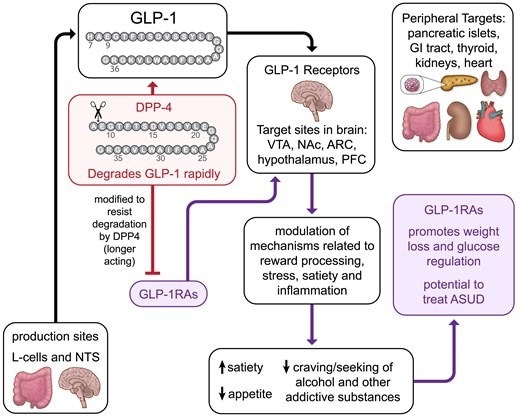 2
Overview of the effects of GLP-1 and GLP-1RAs. GLP-1 is mainly produced by the L cells in the intestines and the NTS in the brain. Endogenous GLP-1 is rapidly degraded by the enzyme DPP-4. GLP-1RAs are engineered to resist degradation by DPP-4, resulting in longer-lasting and more potent effects of the drug. Peripheral targets include the pancreatic islets, gastrointestinal tract, thyroid, kidneys, and the heart, among others. GLP-1Rs are widely distributed in brain regions involved in reward processing, stress, satiety, and appetite regulation such as the VTA, NAc, ARC, PFC, and the hypothalamus. GLP-1-induced appetite suppression is not only mediated by interactions with GLP-1R in the hypothalamus, but also via the vagus nerve and the dorsal vagal/NTS complex. Activation of the GLP-1Rs expressed in these peripheral and central organs and tissues modulate various physiological pathways, thus promoting glucose regulation and weight loss. Furthermore, GLP-1RAs have the potential for treating ASUDs, as discussed in this review. Abbreviations: ARC, arcuate nucleus; ASUDs, alcohol and other substance use disorders; DPP-4, dipeptidyl peptidase-4; GLP-1, glucagon-like peptide-1; GLP-1R, glucagon-like peptide-1 receptor; GLP-1RA, glucagon-like peptide-1 receptor agonist; NAc, nucleus accumbens; NTS, nucleus tractus solitarius; PFC, prefrontal cortex; VTA, ventral tegmental area.2
Effects on reward and craving pathways
Preclinical studies have identified GLP-1 signaling as a modulator of reward processing. Experiments assess its behavioral effects through measures such as voluntary substance intake, responses to substance-associated cues, and renewed seeking after abstinence.1
In vivo models show that activating the GLP-1 receptor in the VTA attenuates reward-seeking responses driven by neuropeptide Y (NPY) and ghrelin signaling.1 In a human AUD trial, exenatide reduced ventral striatal and septal responses to alcohol cues. This neuroimaging finding occurred without an overall reduction in alcohol consumption, so reduced cue reactivity cannot be equated with demonstrated relapse prevention.2
Together, these findings indicate that GLP-1 RA-based interventions may influence substance reward and craving. Changes in experimental behavior or brain activity require confirmation through clinically meaningful outcomes, including sustained reductions in substance use and relapse.1–3
 Image Credit: aipicte / Shutterstock.com
Preclinical evidence
Growing preclinical evidence suggests that GLP-1 RAs can reduce substance intake, reinforcement, or reinstatement of substance seeking in models involving alcohol, nicotine, cocaine, and opioids. Reinstatement refers to renewed substance seeking after experimental extinction of the behavior.1,2
In rodent and nonhuman primate alcohol studies, several agents, including semaglutide, liraglutide, and exendin-4, reduced drinking or relapse-like behavior, with effects varying by dose, compound, and experimental model.1,2 For example, microinjections of exendin-4 into reward-related regions, including the NAc and VTA, reduced alcohol intake in rodents. Some experiments found reductions without corresponding changes in water intake or motor function, but selectivity varied across studies.1
In animal models of tobacco use disorder, nicotine activated GLP-1-expressing neurons in the NTS. GLP-1 signaling through habenular pathways promoted nicotine avoidance, while liraglutide reduced nicotine self-administration (voluntary nicotine taking in an experimental setting) and reinstatement of nicotine seeking.1
In cocaine research, exendin-4 administration into the laterodorsal tegmental nucleus (LDTg) reduced cocaine seeking in rats. These behavioral measures model aspects of relapse rather than directly measuring subjective craving.1
Liraglutide treatment appears to reduce heroin self-administration and fentanyl-seeking behavior in rodents. In one fentanyl model, reductions in relapse-like behavior were comparable to those observed with buprenorphine, a partial opioid agonist used to treat opioid use disorder (OUD); this does not establish equivalent clinical effectiveness.1 Other experiments using exendin-4 found no reduction in morphine-conditioned reward, remifentanil self-administration, or opioid withdrawal, indicating variation across compounds and models.1,2
Limited preclinical research indicates sex-dependent differences in responses to GLP-1 RA treatments between male and female rodents. In one dulaglutide study, male rodents showed sustained reductions in alcohol intake after treatment stopped, while females returned to baseline intake sooner. These findings cannot yet guide sex-specific treatment in humans.1
Clinical trial evidence
A meta-analysis of three randomized controlled trials (RCTs) involving 430 adults and examining alcohol-related outcomes reported no statistically significant overall reduction in total alcohol consumption following GLP-1 RA treatment. Pooled results for drinks per drinking day and alcohol craving were also non-significant.3
Notably, the study populations differed: the dulaglutide findings came from a smoking cessation trial, rather than a trial designed primarily to treat AUD. The meta-analysis inconsistently describes that sample as an AUD population, which complicates interpretation of its pooled findings.1–3
An exenatide-specific trial reported no overall drinking benefit. Still, a secondary analysis found reduced alcohol intake among participants with comorbid obesity, defined as a BMI value of 30 kg/m² or greater. This exploratory subgroup finding requires confirmation and does not establish obesity as a reliable predictor of response.2,3
A separate nine-week semaglutide trial found reductions in laboratory alcohol self-administration, drinks per drinking day, and craving compared with placebo. Semaglutide and exenatide were not compared directly, so these trials cannot establish that one is superior.2,3
Smoking cessation findings were mixed. A small trial of exenatide added to nicotine patches reported improved abstinence and reduced post-cessation weight gain. A larger trial of dulaglutide added to varenicline did not improve abstinence, but reduced weight gain during treatment; that weight benefit was not maintained at longer follow-up.2 A small, single-dose exenatide study in people with cocaine use disorder found no reduction in cocaine self-administration or subjective effects.
New research looks at potential of GLP-1 drugs and addiction
Limitations and research gaps
GLP-1 RAs may affect shared neurobiological networks across several SUDs; however, researchers have not established a generalized clinical anti-craving effect.1,2 Findings vary across compounds, experimental models, and substances. Human evidence is concentrated in alcohol and tobacco research and cannot yet support comparable conclusions across substances.1,2
The small number of human trials, differing populations and outcomes, as well as short treatment periods, limit confidence in the clinical findings. The alcohol trials included in the meta-analysis lasted nine to 26 weeks, leaving long-term effectiveness and safety in SUD populations unresolved.2,3
Large observational datasets suggest associations between GLP-1 RA use and fewer alcohol-related events, including AUD diagnoses and some hospitalizations. These studies cannot establish treatment efficacy or safety, and residual confounding by unmeasured psychiatric and socioeconomic variables remains possible.3
Common adverse effects include gastrointestinal symptoms such as nausea and vomiting, which are usually mild to moderate and transient. Loss of muscle mass is a separate concern, particularly for people with existing malnutrition or sarcopenia (loss of muscle strength and mass); the supplied reviews do not establish it as a rare acute event in addiction trials.2
High costs, tolerability, and weight regain after treatment cessation may complicate sustained use. Their effects on adherence and access in SUD care require direct study, particularly in underserved populations.2
Future directions
Larger, longer, multicenter RCTs should include diverse populations, including people without diabetes or obesity, and evaluate substance-specific outcomes, relapse, nutritional status, and safety.1–3 Future studies should also determine whether GLP-1 RAs provide additional benefit alongside established medications and behavioral treatments for SUDs and how treatment response varies with biological sex, metabolic status, comorbidities, and SUD severity. These findings would help guide dosing and treatment duration.1–3
References
- Völker, K. M., Prechtl, B. L. H., Bormann, N. L., & Choi, D. S. (2026). The potential role of GLP-1 receptor agonists in substance use disorders – a systematic review. Frontiers in Pharmacology 16. DOI: 10.3389/fphar.2025.1702448. https://www.frontiersin.org/journals/pharmacology/articles/10.3389/fphar.2025.1702448/full
- Srinivasan, N. M., Farokhnia, M., Farinelli, L. A., et al. (2025). GLP-1 Therapeutics and Their Emerging Role in Alcohol and Substance Use Disorders: An Endocrinology Primer. Journal of the Endocrine Society 9(11). DOI: 10.1210/jendso/bvaf141. https://academic.oup.com/jes/article/9/11/bvaf141/8277723
- Sinha, B., & Ghosal, S. (2026). The effects of glucagon-like peptide-1 receptor agonists (GLP1-RAs) on alcohol-related outcomes: a systematic review and meta-analysis. Addiction Science & Clinical Practice, 21(8). DOI: 10.1186/s13722-025-00637-z. https://link.springer.com/article/10.1186/s13722-025-00637-z
Further Reading
Last Updated: Oct 18, 2026
 Semaglutide as a promising new treatment for alcohol use disorder