Research using human brain organoids onboard the International Space Station International Space Station (ISS) helped lead to the clinical trial of a potential therapy for Rett syndrome, a debilitating neurological disorder in children. Scientists are now expanding the space-based approach to study other brain diseases to find new treatments.
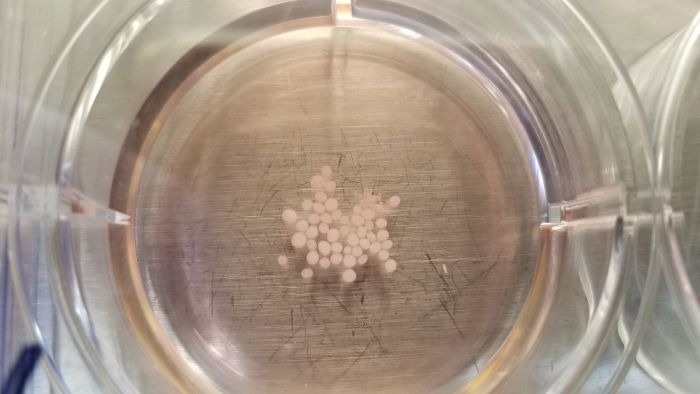 Brain organoids grown in Alysson Muotri’s lab cluster in a culture dish. Image Credit: Alysson Muotri/UC San Diego
A new feature in Upward, the official magazine of the ISS National Laboratory®, follows two research teams using brain organoids in space to study Rett syndrome, Parkinson’s disease, multiple sclerosis, Alzheimer’s disease, and other neurological conditions.
Brain organoids are small, three-dimensional models grown from human stem cells that allow researchers to observe how brain cells develop, communicate, and respond to disease and potential treatments. Because labs build them differently for different purposes, results can vary across models. Even so, brain organoid research in space has grown from a few exploratory studies into a broader body of evidence spanning multiple teams and diseases.
What got our attention wasn’t a single result. It was seeing similar patterns emerge across different investigations led by different teams on different missions using different experimental designs and disease models.”
Michael Roberts, Chief Scientist, ISS National Lab
At the University of California San Diego, neuroscientist Alysson Muotri found that brain organoids sent to the space station showed molecular changes associated with aging and neurodegeneration sooner than comparable models on Earth. In organoids made from the cells of children with Rett syndrome, his team found that normally dormant genetic elements had switched on, triggering inflammation in the brain’s support cells.
That finding led the researchers to test lamivudine, an antiretroviral drug developed for HIV, as a possible way to reduce the inflammation. The work has since helped lead to a clinical trial now underway for patients with Rett syndrome. If lamivudine passes clinical trials, Muotri thinks it may be the first drug treatment for a neurological condition discovered through space research.
Researchers with the National Stem Cell Foundation are pursuing a series of related investigations. Across six missions, the team has flown neural organoids made from the cells of people with Parkinson’s disease and primary progressive multiple sclerosis. The researchers have repeatedly seen changes in gene networks associated with neurodegeneration and are now using the models to study how potential therapies affect brain cells in orbit.
Future experiments are expected to include Alzheimer’s disease models and more efficient methods for studying cells from multiple patients simultaneously. One approach, known as a “village” organoid, could allow scientists to compare how people with different genetic backgrounds respond to the same treatment without requiring a separate experiment for every patient.
Scientists are still working to understand why some biological changes appear more quickly or clearly in space. But after years of testing what models created using human stem cells and neurons can reveal in orbit, researchers are now asking a more practical question: Can these models help identify treatments faster?
 Neuroscientists study the brain circuits mediating experience-dependent decision-making in mice