Researchers pooled evidence across sprint and middle-distance events to test whether a popular nitrate-rich supplement can translate its reported exercise benefits to the pool.
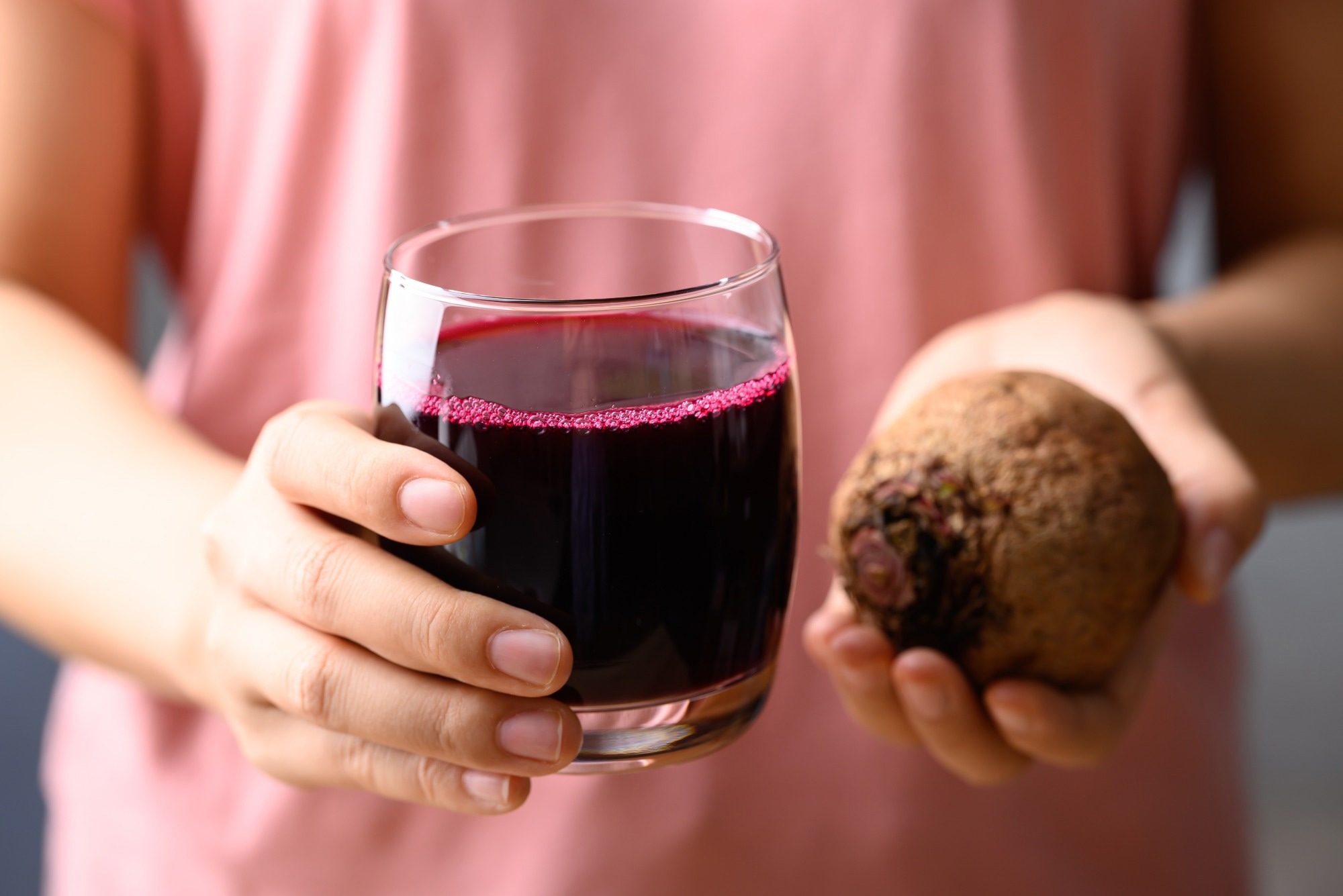
Study: Effects of beetroot juice or dietary nitrate supplementation on swimming performance and physiological responses: a systematic review and meta-analysis. Image Credit: Nungning20 / Shutterstock
Recently, scientists conducted a systematic review and meta-analysis examining whether acute or chronic beetroot juice (BRJ) or dietary nitrate supplementation improves swimming performance, alters post-exercise blood lactate concentrations, and lowers perceived exertion (RPE) in swimmers. This review was published in the journal Scientific Reports.
Ergogenic Effects of Beetroot Juice and Nitrate Supplementation
Prior research suggests that beetroot juice (BRJ) and nitrate-based supplements may improve exercise efficiency, recovery, and training adaptations by increasing nitric oxide (NO) bioavailability. The most consistent effects have been reported with doses of 5–16.8 mmol (300–1041 mg) of nitrate, typically taken as a single dose 2–3 hours before exercise or as short-term supplementation.
BRJ also supplies bioactive compounds, such as betalains, polyphenols, and antioxidants, that may have independent physiological effects. NO-driven vasodilation can contribute to lower blood pressure and increase muscle blood flow. In endurance sports, nitrate supplementation reduces submaximal oxygen consumption, increases ATP production per unit of oxygen, and improves energy efficiency, which may improve exercise economy and has been linked to modest gains in some time trials lasting under 40 minutes. These effects have been studied mainly in male subjects, so responses in female athletes remain less certain.
But evidence for BRJ/nitrate supplementation in swimming is scarce, with most research centered on cycling and running rather than swimming-specific outcomes.
Synthesis of Evidence on the Ergogenic Effects of BRJ and Nitrate Supplementation in Swimming
The current systematic review evaluates the effects of acute and chronic BRJ or nitrate supplementation on swimming performance, blood lactate, and RPE in athletes across various distances. The study hypothesized that supplementation would improve performance while reducing post-exercise blood lactate and perceived exertion.
All relevant articles were obtained from Web of Science, PubMed, and Scopus, up to June 11, 2026, with no publication date limits. Only peer-reviewed articles in English or Spanish were considered.
Eligibility followed the PICOS criteria: (P) swimmers of any sex or level; (I) BRJ or nitrate supplementation before swimming tests; (C) placebo or no supplementation controls; (O) swimming performance, blood lactate, or RPE outcomes; (S) randomized controlled trials, including crossover and placebo-controlled designs. Excluded studies included those involving non-swimmers, mixed sports without swimming-specific data, those lacking controls, those reporting irrelevant outcomes, or those using non-randomized/uncontrolled designs.
The effects of supplementation were compared to placebo or no supplementation. Studies that could not support the predefined meta-analytic comparison were retained for qualitative synthesis but excluded from quantitative analysis. Sample size, mean, and standard deviation were extracted for effect size calculations.
Random-effects meta-analyses were performed for swimming time-trial performance, post-exercise blood lactate, and RPE, comparing supplementation with placebo or no supplementation using the extracted data. For subgroup analysis, swimming efforts were categorized by energy system: maximum sprint (≤30 s; ATP–PCr and anaerobic glycolytic), prolonged sprint (>30–90 s; anaerobic glycolytic), and middle-distance (>90 s; aerobic).
Beetroot Juice Shows No Significant Swimming Performance Benefit, but May Slightly Reduce Perceived Exertion
The initial search identified 61 records; after removing duplicates, 44 records remained. Of these, 12 met eligibility criteria and were included in the systematic review. Nine studies with 120 swimmers provided comparable data for quantitative meta-analysis. These studies generally used randomized crossover designs comparing BRJ with placebo (PLA), mostly involving young adult or university-level swimmers of both sexes.
Participants ranged from competitive, moderately trained athletes to elite athletes. Most studies focused on short-distance races (50–100 m), with some protocols involving repeated sprints and pacing assessments. One study assessed a 168 m backstroke time trial, an unusual distance dictated by clinical constraints and pool configuration. Three studies were included in the qualitative review but excluded from the meta-analysis because one did not use a time-trial measure suitable for the meta-analysis, one used an active comparator, and one lacked extractable quantitative data. Their findings were described qualitatively and could not be combined with the pooled estimates.
The meta-analysis also included physiological and perceptual outcomes, such as blood lactate concentration and RPE ratings. Most studies used the Borg 6–20 scale, with some using the CR-10 scale. Analysis of RPE from seven studies (100 swimmers) showed a small but statistically significant reduction in perceived exertion after BRJ or nitrate supplementation; results varied across studies, and the consistency of this perceptual effect remains uncertain.
Six studies reported post-exercise blood lactate concentrations, contributing seven comparisons involving 69 swimmers, with one providing data for different race distances. Lactate sampling timing varied, but all measurements were taken after maximal or high-intensity exercise. The pooled analysis found similar lactate responses between supplementation and placebo, which the authors interpreted as reflecting similar post-exercise metabolic demands rather than a beneficial or detrimental effect.
The main outcome, time-trial performance, was assessed using various protocols across 120 swimmers, including sprints and middle-distance events. Supplementation did not significantly affect performance compared with PLA.
Subgroup analyses showed no significant effects of supplementation on sprints, prolonged sprints, or middle-distance races, and no evidence that the supplementation effect varied by effort duration. Sensitivity analyses produced comparable findings under different statistical assumptions.
Three studies were rated as low risk of bias, six as having some concerns, and three as high risk because of methodological issues. Publication bias was not assessed because of the small number of studies. A sensitivity analysis excluding studies flagged for potential risk of bias did not materially alter the overall results. According to GRADE, the certainty of evidence for the effect of BRJ or nitrate supplementation on swimming performance is low, mainly because of risk of bias and imprecision in the pooled estimate.
Conclusions
Current evidence does not show a meaningful improvement in swimming performance or a change in post-exercise blood lactate concentrations in trained swimmers. A small reduction in RPE was observed, but its consistency and practical relevance remain uncertain, and it did not translate into performance gains. Current evidence does not support recommending BRJ as a general ergogenic aid for competitive swimming under the studied protocols, while the limited evidence cannot rule out a small performance effect.
This review has several limitations, including a small number of available studies, generally modest sample sizes, and heterogeneity in study protocols, which may limit the generalizability of these findings. The meta-analysis also had limited power to detect a small effect on performance. Future studies should employ larger, well-controlled trials across diverse swimmer populations and competition levels. Research should also explore different supplementation strategies, dose-response relationships, and potential effects on other relevant physiological or perceptual outcomes.
Journal reference:
- Vega-Monzó, L., Ranchal-Sanchez, A., Baena-González, R., Durán-López, N., & Jurado-Castro, J. M. (2026). Effects of beetroot juice or dietary nitrate supplementation on swimming performance and physiological responses: A systematic review and meta-analysis. Scientific Reports, 16(1), 29598. DOI: 10.1038/s41598-026-65495-4, https://www.nature.com/articles/s41598-026-65495-4
 Exercise usually helps the brain. During a 15-day fast, the story was different