Researchers revisited twins with different Parkinson’s diagnoses after a decade, examining how shared genes, lifestyle habits, nutritional status and changing symptoms relate to long-term survival.
Study: Twins Discordant for Parkinson’s Disease: A 10-Year Longitudinal Follow-Up of Mortality, Clinical and Lifestyle Features, Nutritional Status, and Dietary Habits
In a recent study published in the journal Brain Sciences, researchers characterized lifestyle and clinical features, dietary habits, nutritional status, and mortality over 10 years in twins discordant for Parkinson's disease (PD).
PD is one of the most common neurodegenerative disorders and has a complex, multifactorial etiology. Various modifiable factors, such as smoking, dietary habits, and exposure to organic solvents and pesticides, have been implicated in PD. Nutritional status is also relevant, as involuntary weight loss and malnutrition are common in PD. The twin model has been used to study PD for decades.
Monozygotic (MZ) and dizygotic (DZ) twins share 100% and ~50% of their genetic material, respectively, but both share the same intrauterine environment, nutrition, and much of the socioeconomic context. PD-discordant twins offer a unique model for studying non-genetic determinants of PD. Long-term follow-up of PD-discordant twins is scarce.
About the study
In the present study, the researchers assessed longitudinal changes in dietary habits, nutritional status, lifestyle and clinical features, and mortality among PD-discordant twins. Twins discordant for PD were recruited in Italy. In each pair, only one twin met the criteria for PD, while the other had no neurodegenerative disease. Microsatellite analysis was performed to determine zygosity.
Questionnaires were administered at baseline to collect lifestyle and clinical data, including smoking habits, disease duration, gastrointestinal symptoms, levodopa dose, and comorbidities. The food frequency questionnaire assessed dietary habits. Survival status was determined at the 10-year follow-up, and within-pair discordance was re-evaluated.
A telephone interview was conducted at follow-up to update baseline data. The researchers also assessed lifetime exposure to herbicides, pesticides, heavy metals, and organic solvents retrospectively at follow-up. The study's primary endpoint was mortality, while dietary, clinical, and nutritional features were secondary endpoints.
Findings
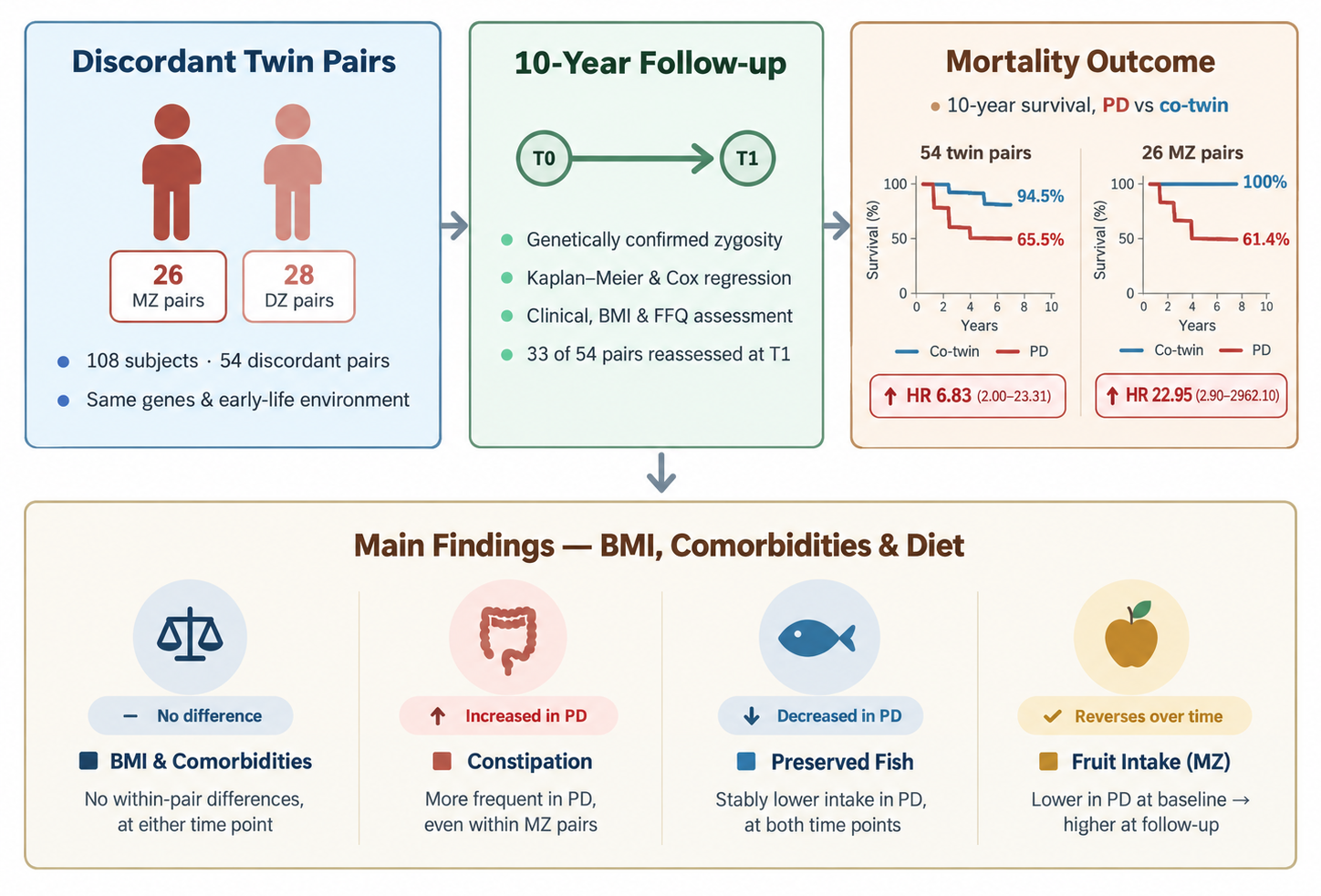
The study enrolled 54 PD-discordant twin pairs, including 26 MZ and 28 DZ pairs, for a total of 108 participants, with an average age of 66 years. At the follow-up, 33 pairs were alive, discordant for PD, and re-evaluated. These pairs were younger, and their affected members had shorter disease duration and lower baseline levodopa doses than those not retained. This may have influenced the follow-up comparisons. Over the follow-up, 17 twins with PD and three unaffected co-twins died, representing 31.5% and 5.6% of the respective groups. In the MZ subgroup, all nine deaths occurred in affected twins. Among DZ pairs, eight and three deaths occurred in the affected twins and unaffected co-twins, respectively.
Reported causes of death among affected twins included neurodegenerative disease complications, cardiovascular events, coronavirus disease 2019 (COVID-19), cancer, and other or unspecified causes. Among unaffected co-twins, two deaths were from unspecified causes, and one was from cancer. Cumulative survival significantly diverged over time between affected twins and their unaffected co-twins.
The divergence was more pronounced in the MZ subgroup, though the small number of deaths made its magnitude uncertain.
Levodopa dose and disease duration increased over the follow-up. At baseline, unaffected co-twins had more frequent active smoking, but this difference was not statistically significant, and smoking rates were similar at follow-up. Overall, smoking status changed little over time. Affected twins experienced constipation significantly more frequently than unaffected twins at baseline in the full cohort and after 10 years among the reassessed pairs.
Regular bowel habits were less common among affected twins; these differences worsened over time, with no significant changes in unaffected co-twins. Comorbidities were not different within pairs at baseline. At follow-up, hypertension appeared to be more frequent among unaffected co-twins, but this difference was not statistically significant. Lifetime exposure to pollutants/solvents was more frequent in affected twins, but this finding did not remain significant after correction for multiple comparisons and was susceptible to recall bias.
Body weight and body mass index (BMI), used to assess nutritional status, showed no significant differences between affected and unaffected twins at baseline or follow-up, regardless of zygosity. Follow-up weight was self-reported, limiting the reliability of these nutritional comparisons. Most dietary habits were similar within pairs, except for two patterns. At baseline and follow-up, affected twins had lower fish intake; only the follow-up difference remained significant after correction within the dietary category. This difference was not significant in the MZ subgroup.
Further, fruit intake was lower at baseline but higher at follow-up among affected twins. Only the MZ subgroup showed a significant baseline difference, while the follow-up difference was significant in the whole cohort and MZ pairs. The dietary questionnaire recorded consumption frequency rather than quantity, and the change to telephone assessment at follow-up may have influenced reported dietary changes.
At follow-up, two MZ pairs were no longer PD-discordant. In one pair, the initially affected twin had a 15-year PD history, while the co-twin had been recently diagnosed, with a 14.5-year difference in the timing of disease onset. The second pair had a 12-year difference.
Conclusions
Ten-year mortality was substantially higher in PD twins than in unaffected co-twins. All deaths in the MZ subgroup occurred in affected twins, suggesting that shared genetic background alone cannot explain the excess mortality. The conversion of unaffected MZ twins to concordance suggests that the disease may manifest at different ages even in genetically identical individuals.
Comorbidities and nutritional status did not differ significantly within pairs, suggesting that these variables may not be sensitive markers of divergence over the follow-up. The small sample does not establish equivalence between groups or rule out other influences on survival. Constipation, the most consistent clinical difference, worsened over time among affected twins. Dietary differences were limited. Some secondary findings remained significant after correction within individual categories, but none remained significant after correction across all 78 comparisons, so they require confirmation. Further research is needed to delineate mechanisms linking PD progression to survival.
Source:
Journal reference:
- Barichella M, Natale A, Contaldi E, et al. (2026). Twins Discordant for Parkinson’s Disease: A 10-Year Longitudinal Follow-Up of Mortality, Clinical and Lifestyle Features, Nutritional Status, and Dietary Habits. Brain Sciences, 16(10), 1102. DOI: 10.3390/brainsci16101102, https://www.mdpi.com/2076-3425/16/10/1102
 Abiraterone triplet therapy improves long-term survival in metastatic prostate cancer