At a modest scale, dome‑based patient‑derived organoid (PDO) culture often requires tens of hours of manual work each week. Since manual culture workflows rely significantly on operator skill, they introduce variability and push routine tasks into evenings and weekends.
The CellXpress.ai® Automated Cell Culture System is specifically engineered for dome‑based organoid culture, replacing hands-on processes with completely automated, image‑guided protocols, preserving culture quality.
This enables skilled scientists to be redeployed to other, high-value tasks such as designing experiments or analysing data, making labs more efficient and ultimately accelerating research programs. Additionally, AI-based decision making coupled with automation ensures much more consistent organoid culture, which reduces assay noise and thus ensures more robust, reproducible assays further downstream.
Why choose the CellXpress.ai system?
The CellXpress.ai system supports both routine and complicated dome‑based organoid processes by incorporating liquid handling, incubation, and automated imaging into one continuous workflow.
Dome culture is among the most labor‑intensive and operator‑sensitive processes in routine use. The CellXpress.ai system standardizes each stage, from seeding through to passaging, by applying clear, image-derived decision requirements. This approach minimizes variability, hands-on intervention, and dependence on user expertise.
AI-based automated decision-making for organoid passaging via the CellXpress.ai system
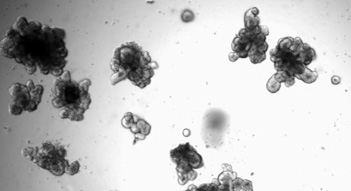
Organoids imaged using transmitted light (TL). Image Credit: Molecular Devices UK Ltd
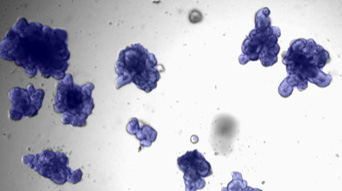
Organoid segmentation with SINAP (deep-learning model). Image Credit: Molecular Devices UK Ltd
How it works:
- Organoids are periodically imaged in TL, and images are segmented by the software’s deep-learning tool, followed by analysis for a range of phenotypic measurements.
- They are subsequently classified for “mature” and “immature” phenotypes via AI-based classification.
- Passaging decisions are automatically triggered by the software, based on the presence of sufficient mature organoids in culture.
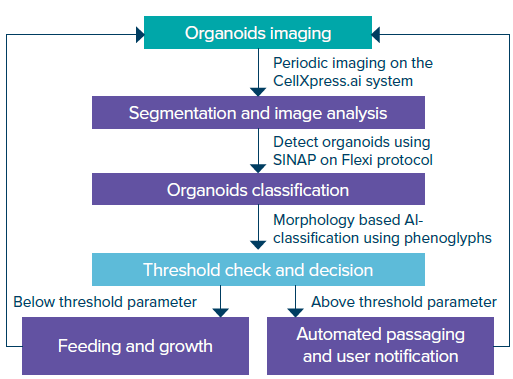
Organoid passaging using AI-based decision making on the CellXpress.ai system. Image Credit: Molecular Devices UK Ltd
Client challenges addressed
- Time‑intensive maintenance: Approximately 20–25 hours per week at modest scale
- Limited scalability: Culture capacity restricted by expert availability
- Operator-dependent variability: Inconsistent dome handling and decision‑making
- After‑hours burden: Routine feeding, monitoring, and passaging outside normal work hours
Adopting the CellXpress.ai system allows laboratories to consistently manufacture large‑scale organoid cultures without increasing headcount or compromising quality.
Automated processes enhance reproducibility, minimize operator reliance, and transition routine culture tasks from manual to hands‑off operation. This enables scientists to focus on more important work while maintaining consistent, predictable organoid fabrication.
Weekly hands‑on time: dome‑based tissue-derived organoid culture (10 x 24 well plates, two plates processed simultaneously). Source: Molecular Devices UK Ltd
| Activity |
Occurrences per cycle |
Manual hands-on time (per event) |
Total manual hands-on per cycle |
The CellXpress.ai system operator hands-on time |
Hands-off time gained |
| Organoid dome seeding (matrix-dependent) |
1x |
30 minutes |
150 minutes |
0 minutes |
150 minutes |
| Organoid feeding/media exchange |
3x |
8 minutes |
120 minutes |
0 minutes |
240 minutes |
| Imaging for maintenance decisions |
6x |
15 minutes |
450 minutes |
0 minutes |
450 minutes |
| Organoid passaging (1:3) |
1x |
95 minutes |
475 minutes |
0 minutes |
475 minutes |
| Media and consumable replenishment (exception) |
Periodic |
- |
- |
90–120 minutes |
0 min |
| Total hands-off operator hours saved |
22 hours |
24/7 operation without 24/7 staffing
Staff presence is not required for feeding, monitoring, and passaging; they occur at a biologically appropriate rate. Decisions surrounding the analyzed cultures are made according to predefined criteria, not staff availability.
Download your copy now
About Molecular Devices UK Ltd
Molecular Devices is one of the world’s leading providers of high-performance bioanalytical measurement systems, software and consumables for life science research, pharmaceutical and biotherapeutic development. Included within a broad product portfolio are platforms for high-throughput screening, genomic and cellular analysis, colony selection and microplate detection. These leading-edge products enable scientists to improve productivity and effectiveness, ultimately accelerating research and the discovery of new therapeutics. Molecular Devices is committed to the continual development of innovative solutions for life science applications. The company is headquartered in Silicon Valley, California, with offices around the globe. For more information, please visit www.moleculardevices.com.
Sponsored Content Policy: News-Medical.net publishes articles and related content that may be derived from sources where we have existing commercial relationships, provided such content adds value to the core editorial ethos of News-Medical.net, which is to educate and inform site visitors interested in medical research, science, medical devices and treatments.